Amazon at Mobile Portland on Monday November 12

If you live in or near Portland I highly recommend coming out to Mobile Portland on Monday November 12. A senior Amazon Director, Aaron Rubenson, is coming down from Seattle to talk Kindle Appstore. As Jason Grigsby [1] said in his post on the topic:

I’m keenly interested in learning more about what Amazon is doing and what opportunities look like. I want to learn more about what Amazon can do for developers and entrepreneurs that other platforms don’t. I want to understand how to maximize our potential on the Amazon Kindle platform.

The last year has included a number of big events with some big names. We’ve had Microsoft, Nokia and now Amazon, among a host of other great speakers and panelists. I’m hoping we can attract a large crowd and show those who haven’t come yet that they are missing out. These are exciting times in mobile, Portland is a hotspot for developers and others in the mobile space. Let’s show them all why they need to be here.

RSVP today.

[1] I’m on the Board along with Jason and Dylan Boyd.
My Daughters Review The iPad mini

I received an iPad mini November 2nd and have played with it ever since. Well, actually, I played with it for a few hours and then my daughters have dominated the device ever since. When they reach for a device to practice math or work on their spelling, it is now the iPad mini. When I ask them why the mini over its big brother they say exactly that: size. The device is perfect for their little hands and bodies. It’s the right weight for them and doesn’t feel like a brick they have to lug around.

This is why the device will do well. I think schools will love this sized device [1] and anyone into media consumption and reading will love this sized device. It’s a little small, I think, for a productivity tool but then again that’s why we have bigger tablets and laptops to choose from.

For my own purposes I still prefer the bigger devices. Yes, I use mine for a lot of media consumption, especially reading. But I also want to be productive with it. Will that change in time? I can emphatically say maybe. With a quick trial I can tell you that I had no problem typing on the smaller, landscape keyboard instead. But before I will use it every day I’d like to see the fonts adjust a little bigger and the screen become a little better. I prefer the retina display.

So for now I will stick with the iPad 3. But I can see a day where a device small enough to stick in a back jeans pocket or inside jacket pocket will end up being way more attractive to me then the 10″ device. It already is for my daughters and, well, they are the future. 🙂

[1] I really like the Nexus 7 I’ve been playing around with, too.

The Next Decade For Microsoft

Two days ago I was talking about products soliciting strong opinions. A decade ago Microsoft was an opinionated company. People loved to hate them and other people were in love with them. Just the mention of Microsoft could solicit a fight among friends. But the last decade hasn’t been kind to Microsoft. As the market fight has shifted from desktop to mobile, the world has stopped talking about Microsoft. Marco Arment said something quite profound about the difference between the two companies:

Apple’s products say, “You can’t do that because we think it would suck.” Microsoft’s products say, “We’ll let you try to do anything on anything if you really want to, even if it sucks.”

Enter Windows 8. Enter the Windows 8 RT tablet. Enter the punditry suddenly discussing Microsoft again. In fact, it isn’t just the technorati discussing them. I haven’t heard this much discussion of Microsoft among the Apple community in ages.

Here’s the bottom line for the new Windows tablets: they are worth a discussion. The devices are interesting, the keyboards are interesting, the development tools are interesting. It is the first Windows computer in 10 years that would make me look twice at Microsoft’s world.

The Apple community wants to make this a battle between Apple and Microsoft, between Windows 8 and iOS. But that’s not what Microsoft is doing here and I understand that completely now. For Microsoft this is a battle between Windows XP and Windows 8. This is a battle between the old world of CRT monitors and the modern world of portable computing. Windows 8 is meant to be the next generation computing device for the 1 billion Windows installed base; not the competitor to 100 million iPad and Mac computers. It doesn’t need to have a million apps today and doesn’t need to have the perfect Office installation. It needs to have enough to keep people paying attention, talking about Microsoft, and make those who were going to upgrade stay with Microsoft.

Window 8 RT is a very interesting device. It does more than enough to make those who primarily want a notebook computer pay attention. I think it is going to be a big success and will keep Microsoft among the technology elite for the foreseeable future.

Sucked Into The Undertow

John Gruber on The Talk Show podcast, episode 20:

A lot of this change is not really your choice. You do often have a lot of choices in life but a lot of it is you’ve got to get with the program ’cause the train is leaving the station and if you’re not on it you’ll be left behind. … Rising tide lifts all boats. Also, a rising tide often sucks you down the undertow and you drown. … If you are too attached to what you’ve done, to the way things work, to what you were good at, you can really get into trouble because the world around you moves forward.

I found myself, this past weekend, reviewing old copies of FCPlus Professional, powerOne Finance and powerOne Graph manuals. These date from 1998-2001. FCPlus Professional, the fore-runner to powerOne Finance, was particularly interesting. The first version, which we shipped in March 1998, was very under powered with very few financial calculations. We were selling it for $39.99 per copy and customers were ecstatic at those prices. The powerOne products in those days started at $49.99, eventually went to $59.99 with high-end versions as much as $159.99. Oh, with upgrades every couple of years. Here we are a decade later. $4.99 is expensive with no upgrade revenue.

I know this is a song I keep singing here. As John said, you can’t stand still. The world keeps moving and we’ve got to move with it.

That’s exactly what I’m doing…

The Next Frontier: Digital Tickets

Apparently, MLB rolled out its Apple Passbook experience the last couple of weeks of the season:

In the two weeks that the Passbook program was in place at four Major League ballparks, Passbook accounted for 12% of sales of single game tickets purchased online, around 1,500 in total. Those numbers seem pretty darn impressive, the parks are not minor ones, and that’s a decent chunk of ticketing. But they get even more impressive when you think about the breakdown.

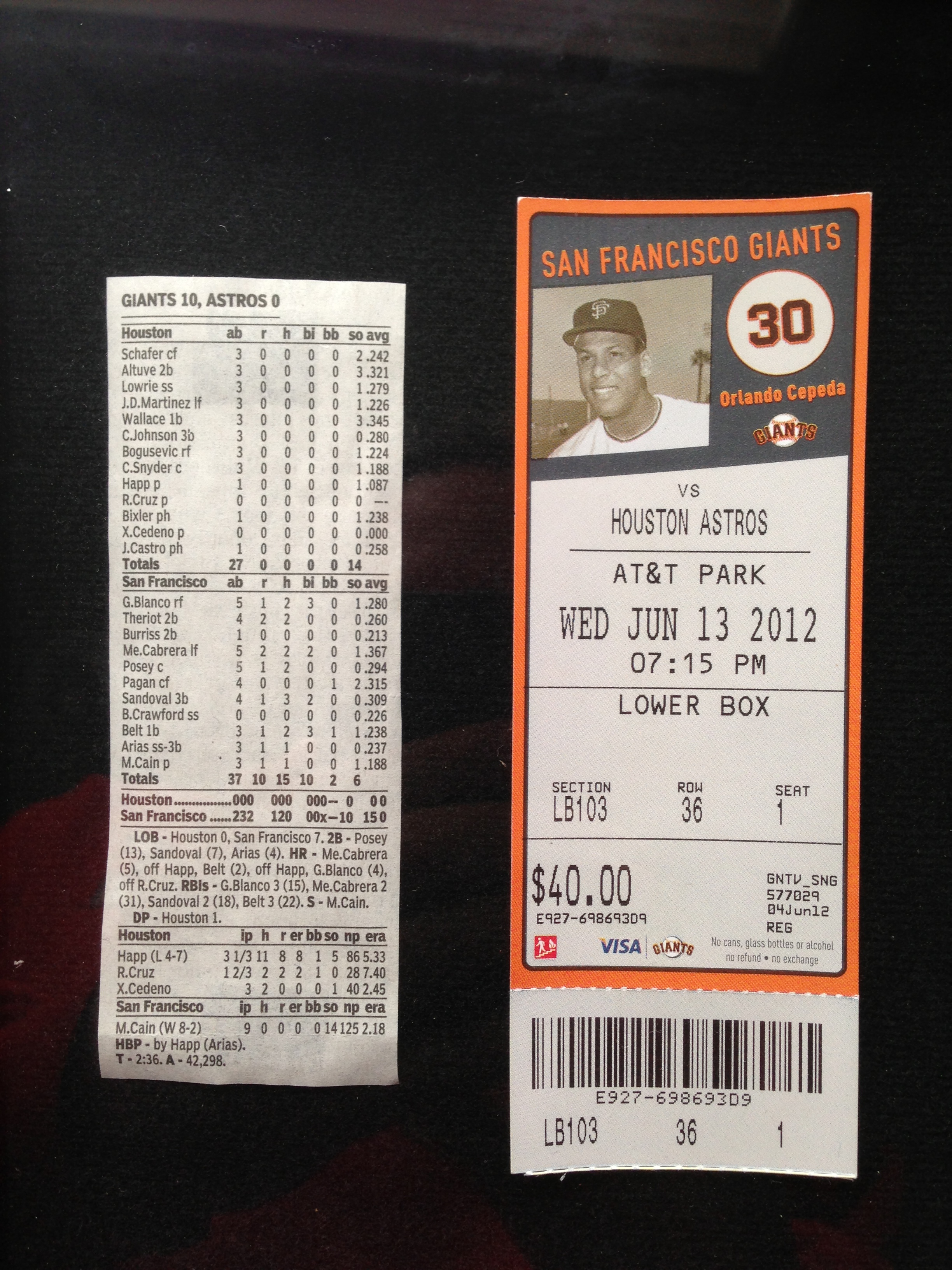
I have a box in my closet filled with ticket stubs for every event my wife and I have ever been to. That’s more than 17 years of movies, concerts, ball games, etc. Normally I’m a big digital guy as I hate the clutter and dust. But what happens to my shoe box when there are no more ticket stubs?

The picture is my MLB ticket stub and box score from Matt Cain’s perfect game this summer.