A Massive Undertaking

I’ve wanted to update powerOne for six months now, ever since the iOS 7 announcement. Actually I wanted to update powerOne long before that. The problem is I couldn’t justify it. The product’s sales have dwindled horribly over the years and even a weeks worth of work was more than a months pay. I didn’t have the money or time to devote to it.

But still… it’s powerOne! It’s the product I’ve labored over for more than a decade, that has been with me through marriage and children, love and loss. Not working on powerOne, letting it languish and die, felt like I was a god handing out cancer to long ago friends.

I’ve been trapped in this hell for months, trapped between I can’t pay the bills with this product and I don’t want it to die. I spent too much time thinking about how to revive it and modernize it. What if powerOne was free with ads? What if we could make it easier to create templates? What if there was only one version? What if we could turn it into a web service? What if… what if… what if.

But the reality is the product was designed for a different software era. It was designed for an era when we called it software and spent $100 for it. It was designed for an era when most software was sold in the US. It was designed for an era when there was two major mobile computing platforms, Palm and Windows Mobile, not one where we think about Android and iOS and Mac and Windows and web (and maybe Windows Phone).

Most of my time has been spent on contract work this past year or so, mostly out of necessity. Got to pay the bills, after all. And any extra time we’ve had Rick and I have worked on Equals, which in my mind is a better powerOne, designed for the modern app era with many of powerOne’s shortcomings in mind.

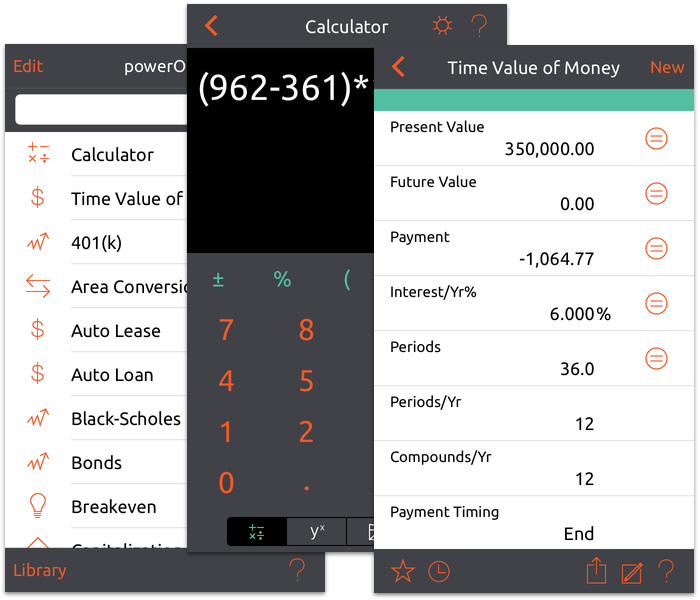
So here we are, reaching the end of 2013, almost six months after iOS 7 was announced and three months after it launched. powerOne sales continue to languish and I have a gap in my schedule as I await Rick’s work on Equals. Finally, a chance to work on powerOne. We already had the designs. I just had to convince myself not to do a major overhaul. Modernize without disrupting, as much as possible.

And that’s where I have been the past week, trying to modernize powerOne. I thought, given other experiences with iOS 7, that it shouldn’t take more than two or three days of heavy lifting. Ha! Updating the calculators (iPhone and iPad are separate) alone took three days! I worked straight through the weekend and I’m still going as of this writing.

It’s not going to make it in time for Apple’s break (Dec 21-27) but we should be ready soon thereafter. I’m at least excited to see the old girl with a beautiful new facelift and some fine-tuning under the hood. She looks thoroughly modern. And who knows? Maybe that’s all she needs to help pay the bills again.
p1_composite


Looking Back At Horrible Code

I’ve spent the last week looking at old code. This has been very enlightening. On one hand, this code is decrepit and old. Most of it was originally written three designs and six years ago. There are tons of stupid and ridiculous coding decisions that I would never make today.

But that’s exactly why I am so optimistic. Yes, my code sucks from six years ago. But I know that it sucks. That means I’ve learned something about better code since then, and that’s exciting!

Joe Posnanski, one of the greatest sports writers on the planet, made this comment at the bottom of one of his articles:

One of the most underrated talents in baseball, and probably in life, is showing up.

Absolutely. But it isn’t just showing up and hanging around the back of the room. It’s about showing up and trying to take away something new every day, every week. For six years I keep showing up, reading Apple’s docs, reviewing StackOverflow posts, working XCode. So while my code sucked six years ago, it is significantly less embarrassing today.

I hope in six years I look back and think today’s code sucks, too.

App Rating Requests And Optimizing For Success

There’s been a storm brewing the past week in developer circles about the “Rate This App” dialogs appearing in apps. These have been around since the dawn of the App Store so I don’t know how this got started now.

I could care less about this discussion. The reality is that, in the app stores, only a couple of things matter: name, icon, screenshots, ratings, and sales. That’s it. Ratings and sales are intertwined. More of one means higher rankings (both in category and search), which means more people find and buy your app, which means higher rankings. Personally, I am not surprised to see these dialogs appear nor do I hold it against the companies who ask.

While some of these dialogs are worse than others, it is insane to expect people to skip optimizing around one of the few things they can control when it comes to app store sales. Reviews matter. Even worse, current app release reviews matter most. Every bug fix means the review count returns to 0, which means it is in developer’s best interest to ask you over and over again for a review.

Don’t like it? Delete the app. It will stop asking.

Developers complaining about the practice: why does no one point the finger at Apple? We optimize around what brings us success. [1] If Apple deemphasizes ratings and reviews than these boxes will disappear.

David Smith wrote a long post called Degradation and Aspiration. In it he wrote:

I want to believe that the App Store is a special place. I want for it to be the singularly best venue for customers to come and find innovative, well designed, quality software. Software that pushes the boundaries of what is possible and continually amazes and delights its customers. I want for there to be an aspirational pull upwards on my own development. I want to feel like I need to work extra hard to make sure my apps meet the high standards my customers have been trained to expect.

Oh, how I wish I felt this about the App Store, David! I long ago lost this feeling, if I ever even had it. There is just too much crap mixed in with too much great software, and too many instances of that crap rising up the sales charts while great stuff languishes in obscurity.

In the long run, and as I’ve discussed here before, I think the app stores are forcing fundamental changes in the nature of the software business, one that those talking about this issue of app ratings won’t like either. More apps with advertising, more apps free with in app purchases, more apps that use psychology to get you to pay, more apps that use tricks and slight of hand to make money.

I love David’s sentiment. I wish it were so. But I’m afraid we’ve long past that point. The App Store is just one giant Walmart, but without the greeters.

[1] I never employed one of these dialogs in powerOne — considered it but couldn’t find the right time to ask — but when we would ask for reviews in the in app blog we would see a huge upswing in reviews and a huge upswing in sales, often 30-40% improvement.

The Questions No One Thinks To Ask

Steve Blank wrote an incredibly good post asking three questions that I rarely hear asked. Most people, when starting a business, only think about the positives, about the upsides, and don’t think about what they are really doing and the impact it has on those who start that business. The reality, though, is that the years spent working on any individual business are years spent not doing something else. Yes, there is an opportunity cost, even though we don’t know what the cost is at the time we are making the decision.

The questions Steve asks, in addition to the normal business ones:

1. Do you want to spend the next 3 or 4 years of your life doing this?
2. Is this a scalable business?  And if not, are you ok with something small?
3. If I didn’t make any money after 4 years, did I still have a great time?

These are such critical questions, ones I have been asking myself over the last couple of years. 1 and 3 I have answered definitively. 2 I still struggle with.

Generational Smackdown

Robert Samuelson wrote an article that I have been thinking about for a while. There is a fight happening in this country that pits the young versus old, worker versus retired, child versus parent:

The elderly’s interests are running roughshod over other national concerns . Social Security, Medicare and Medicaid — programs heavily for the retired — dominate the budget, accounting for about 44 percent of spending, and have been largely excluded from deficit-reduction measures.

Almost all the adjustment falls on other programs: defense, courts, research, roads, education. Or higher taxes. The federal government is increasingly a transfer agency: Taxes from the young and middle-aged are spent on the elderly.

And Social Security, Medicare and Medicaid are only growing as portion of our government dollars.

It’s uncomfortable but frankly, I’m tired of being pushed around by my parents and grandparents generation. Our school budgets are cut, our roads don’t get repaired, our cities file bankruptcy, all while they give themselves the retirement benefits they promised themselves.

Samuelson’s right: we are beginning to stir.