2014 Software Business Models

I have to admit, I generally hate New Year’s posts. You know the ones I mean, right? Some silly “look back” at the year before or some bloviated “look ahead” at what the new year will bring, lamenting all the lost opportunities and swearing the author will do differently [1]. First of all, I think few care (except the person writing it). Second, the new year is artificial. You want to do better in August? Then do better in August. But no one ever writes these screeds in August.

But then Ben Thompson came along and wrote the New Year’s post that is better than all the others, as it is actually practical and supposed to be for us, not him. Ben wrote an absolutely fantastic piece called 2014 Business Models that is well worth the read for anyone trying to make a living selling software (oops, apps) in 2014.

There are two concepts he discusses here. First he sets up his business models by first discussing marginal cost, and this is incredibly important to understand in the “download” economy:

The implication for apps is clear: any undifferentiated software product, such as your garden variety app, will inevitably be free. This is why the market for paid apps has largely evaporated. Over time substitutes have entered the market at ever lower prices, ultimately landing at their marginal cost of production – $0.

Marginal cost of a single additional unit is 0. Development is sunk cost.

Then he explains his business models. I won’t spoil the fun or rip off his excellent writing here. Go read the entire article.

[1] On occasion I’ve written these too and, after the fact, hated myself for doing it.

Sunk Cost

Sometimes it just isn’t working. We have this window of opportunity to get a first beta version of Equals shipped and, for goodness sake, it just isn’t getting done. Here’s the problem: we realized last year that delivering the iOS version first was a mistake. Instead we needed to do a web version first.

Equals is partly written in C, partly in Apple’s Objective-C, and partly in Javascript, but the Javascript code was done before either of us had any experience writing HTML5. (Read: hack job.) If we were going to do a true web version then we needed money (time) and we needed to learn Javascript so we lined up a contract job that paid us to learn it. It was painful (unstable, new platform without much documentation) and it didn’t buy us as much extra time as we would have liked, but it worked. By the time we were done we could re-write the code for Equals.

But too much of Equals code was still in Objective-C, which won’t work for the web version, so we needed to move it into C. Rick started to make the changes. He made it part way and then was interrupted by a health issue (now stabilized) and then contract work. He started again in late December. He thought three weeks.

Four weeks later and it isn’t done. In fact, Rick looks exhausted. He isn’t sleeping well and even days off don’t feel like days off because it isn’t done. Worse, every time he makes a change it breaks other code, so it is really fragile. Edge cases are killing him. He told me Monday he just stares at the code, not knowing what to do anymore.

I’ve been worried about the fragile code for a while. I’ve also been concerned about storing the notes in HTML as every browser changes it and will make it very hard to track changes some day. We needed a different approach.

The fundamental problem is that the code was written to handle text. When we added HTML, it was added as a side layer as to not disturb the functioning engine. Originally Rick was trying to strip the HTML, note the cursor position (which HTML doesn’t want to handle correctly to begin with), make adjustments as the code was changed, then add everything back in. As mentioned this wasn’t working.

So I suggested we change the approach. A la Markdown, which gave me the idea, I suggested we just replace the HTML with our own “markdown”, text that Rick could safely ignore and that we could store as a neutral format in the database. In fact, Rick realized we could use a feature from an early version of the app that we are no longer using, one that already was being ignored. The first thing Rick gets to do is rip out months of code.

Sunk cost. It doesn’t matter anymore.

Now we are back on track, I hope. Let’s hope we don’t hit any major snags. It is time for people to start using Equals.

Learning From Our Customers: Soliciting Feedback For powerOne v4.1

A week ago we released a major update to powerOne that brought the look of the application in line with iOS 7. It was a major overhaul. Every aspect of the application was touched and, in the process, plenty of bugs were found and squashed.

The release created a minor uproar among some of our customers though. While some people absolutely loved the re-design, others hated it. From most of those customers we received very constructive feedback, including many things we didn’t, and in some cases couldn’t, have foreseen before releasing.

We learned things like the new look was hard to see in sunlight (we live in Oregon so don’t see sun this time of year :-), it was particularly hard on color blind people (should have thought about that one especially since my wife’s brother is color blind), the contrast wasn’t strong enough for poorer eyesight, and the buttons felt smaller (only because there were no borders as in reality all buttons are larger).

We are human over here, folks, and we work very hard to make the best choices we can. We do what we think is right then we get feedback and make adjustments, which is what we are doing now.

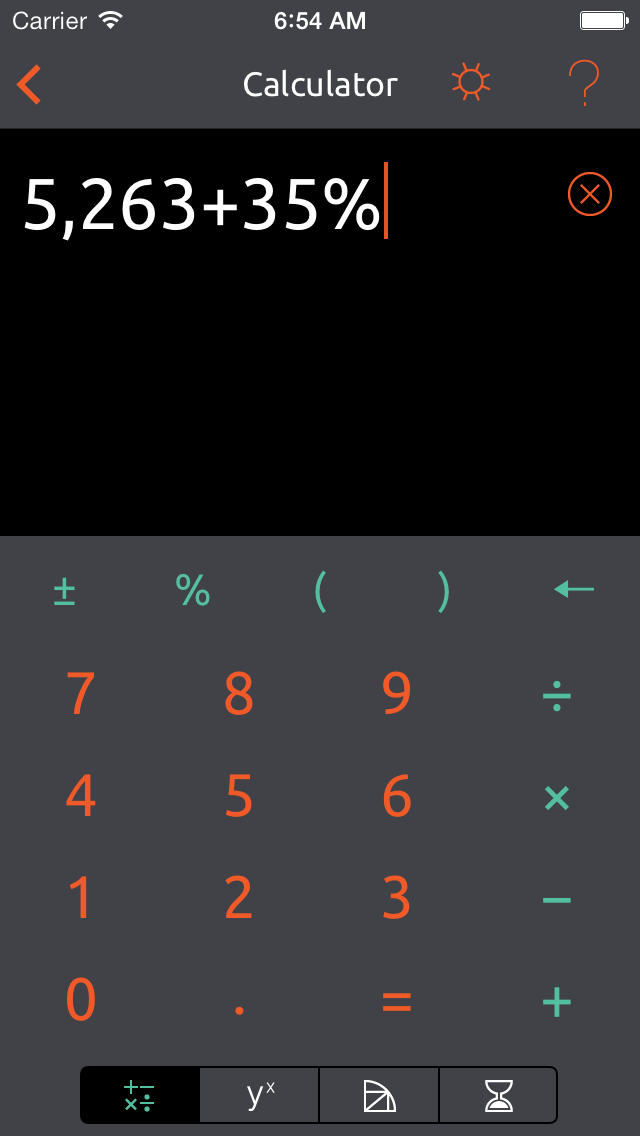
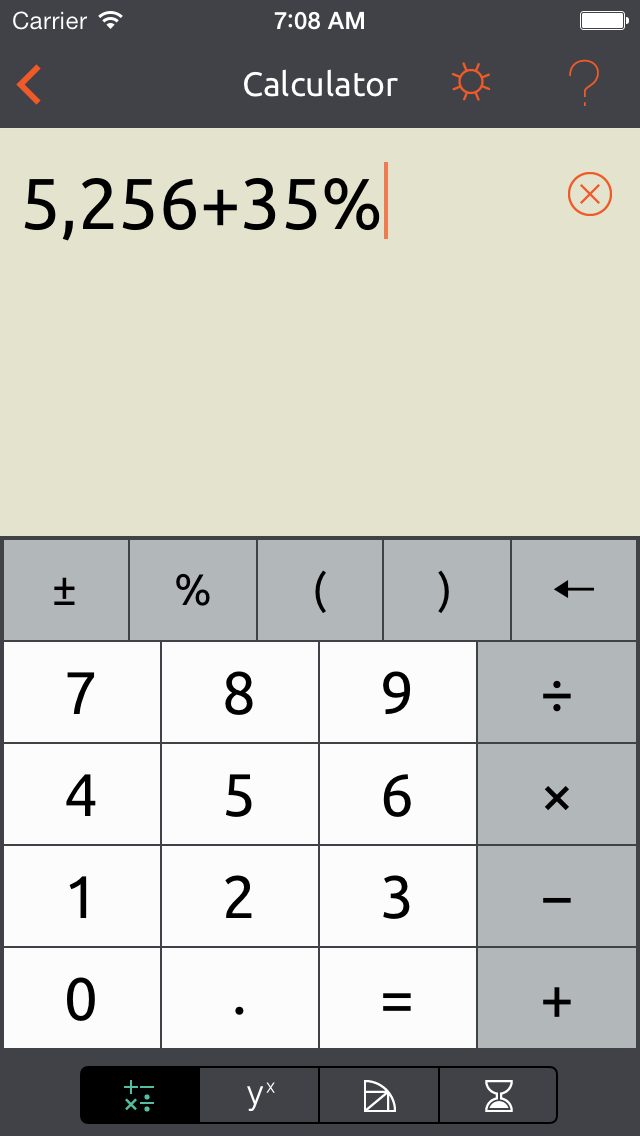
Here is what we are going to do: instead of one calculator design option, we are going to give you three. The themes will be available in the calculator settings. Since we made the mistake last time of not soliciting feedback, I thought this time we would. I’ve added the three screens here. Please leave a comment to this post or email help@infinitysw.com to tell us what you think.

theme #2
Theme 1: This is the original v4.0 theme. We still really like this and think it is the closest we can get to the iOS 7 design aesthetic. While it will be available, however, it will no longer be the default. It might just be a little too radical for some.


theme #3
Theme 2: This theme is designed to be as close as we can get to the version 3 design but remain true to iOS 7. This theme should be good for those that need high contrast or just prefer the old look.


theme #1
Theme 3: Personally, I’m tired of all the white and black in iOS 7 and wish people knew how to use another color. This theme still provides those striking colors prevalent in v4.0 but also provides more contrast a la v3. This will be the new default.

Again, I’m looking for your input, especially from those of you who don’t like the version 4.0 re-design. Please leave a comment here or email help@infinitysw.com.

Buggy Software

MG Siegler wrote:

Since the moment it was unveiled at WWDC in June of last year, I’ve been a big fan of iOS 7. While I certainly understand the people who hate change, I am not one of those people. In technology, I welcome change — especially big, bold changes. At the very least, it shows that a company isn’t afraid to experiment. More importantly, it shows that a company isn’t content to rest on its laurels.

So I embraced the gaudy neon and I entered our newly flat world excited. And I remain convinced that in just about every way, iOS 7 is a huge upgrade over the previous iterations. Except one. And it’s a big one.

The software is so inexplicably and inexcusably buggy.

I’ve noticed the same thing and the problem seems to be getting worse over time. It seems, once upon a time, that when Apple shipped a new release it was pretty stable but this doesn’t appear to be the case anymore. Maybe it really never was.

iOS 7 of course was a major change. Add to to this fact that Apple is now supporting a ridiculous amount of software titles. Not only do they have iLife and iWork titles across three platforms (web, iOS, Mac) but they also support professional titles like Aperture, Final Cut Pro and Logic Pro, developer tools like XCode and all of its universe of sub-applications (like Instruments and Simulator), all the iOS and OS X bundled applications including many that require data like Maps, and iCloud. And this list doesn’t even include the grandaddy of software apps, iOS and OS X themselves.

I want to feel sympathetic. After all I know what it is like to support software. On the other hand, I have to use this stuff.

Breathing! I Should Have Tried This Earlier.

A week and a day ago I had surgery on my nose [1]. I had both septoplasmy to fix a deviated septum and turbinate reduction surgery. Turbinates are in the nose and help to filter, warm and humidify the air before it passes through to the lungs.

For as long as I can remember I’ve been unable to breath well through my nose, and it has gotten worse as I’ve gotten older. The good doctor told me that the turbinates swell for two reasons. First, a deviated septum causes more air flow through one nostril than the other so the turbinate on the non-herniated side grows to handle the extra flow. Second, untreated allergies have an effect. I’ve had allergy problems as far back as I can remember and in the 1970s and 1980s there was no good medical treatment except remove the offending allergen. With the rise of nasal sprays in the 1990s it became a lot easier to treat and control.

The surgery was under general anesthesia. I remember them wheeling me into the operating room, I remember him telling me he was starting the flow of drugs and then… it was that fast. I woke up in recovery, very groggy and not thinking at all. I slept on and off for a while, having some problems as every time I’d fall asleep my blood oxygen level would drop too far and the alarms would go off, waking me up. Eventually I realized that sleeping on my back was part of the problem and it stopped happening when I rolled on my side, so they sent me home to bleed in piece.

They gave me all kinds of stuff: gauze for under my nose, a little rolled up mask to keep it in place, pain medication, an antibiotic, and anti-nausea medication. They gave me crackers and breathing stuff (because of the blood oxygen levels) and other things, too. I took the antibiotic but never needed the pain or nausea medications [2].

The bleeding lasted about 24-36 hours, at which point it mixed with and slowly turned to a steady stream of mucus, which did slow up as the week progressed but never truly stopped. It mostly sounded and felt like I had a head cold. I also used a nasal irrigation system throughout the week, spraying a water/mild salt solution up my nose to keep things cleaned out. I thought this would be horrible. It wasn’t.

The biggest problem I had was eating and brushing my teeth. Can’t breath and chew in the same orifice, it turns out. So I would have to hold my breath, chew, chew, chew, gasp for breath as I ran out of oxygen. More than once my family laughed at me. It was pretty comical.

After one week (yesterday) I returned to the doctor who took out a stitch, removed the stints (packing) from my nose and checked things out. He said it looked great in there and immediately my nose cleared up. The amount of air was almost overwhelming. There was so much oxygen that it almost hurt, maybe the best pain I’ve ever felt. It was awesome! I have a little swelling today, which he said is normal and will pass in the next couple of days, but I can breath through my nose better than I could before the surgery even still.

As for work, I took off three days through the weekend and then worked a partial day on Monday. Tuesday, though, was mostly full-time again although I was very tired the next couple of days. For exercise I was able to walk a little but am very restricted. No weights or bending exercises, no swimming, so I am mostly on the elliptical right now or walking, although I don’t have the stamina to go very long or far. I’ve dialed back the intensity, too, and will build back up over the next couple of weeks.

If you are considering such a surgery I want you to know that it wasn’t too bad, especially after the first two days. I can tell you that breathing through my nose decently for the first time in my life, though, was well worth every second.

[1] I appear to only have surgery in years that are divisible by 10. I had cancer surgery at 20, again at 30, and now nasal surgery at 40. Outside of a few extracted teeth, I have never otherwise had surgery, local or general anesthesia.

[2] Except amusement park rides I rarely feel nauseous. And as for pain, I have a high tolerance. I once, after surgery a decade ago, had a stitch put through a nerve. That pain would leave me crumpled on the floor, stars in my eyes, but I didn’t take the pain medication. Given that, I never even felt the slightest twinges of pain with this surgery.