Innovation Lacking on Math Show Floor

I spent yesterday on the show floor at the National Council of Teachers of Mathematics (NCTM), a K-12 organization aimed at helping advance the teaching of mathematics. What was particularly stunning was the lack of innovation technologically happening there.

The show floor was much smaller than in years past. The floor used to be huge, taking at least three hours to walk the entire thing. This year I walked slowly and did it all in just over an hour. I heard attendance was way down, too. Back when I had a booth at the show, six or seven years ago, the attendance usually hovered around 15,000.

The other trend was that there were fewer 10×10 booths than I remember, the smallest size available. This might be because of consolidation in the industry or companies like Casio trying to make a bigger splash. TI’s booth and Key Curriculum Press, two of the bigger players in math education, was tiny in comparison to years’ past.

Back to technology. Most of it was “old world” stuff. Calculators were dominant as always. (And here I have to give TI credit as their new nSpire calculator is quite nice to look at and their desktop software, albeit complex, is a step forward.) There was the usual assortment of desktop software: Geometer’s Sketchpad, Calculus in Motion. And a couple of new companies on the scene, Desmos.com who offers a free online grapher product and got some press a year ago because of Techcrunch demo days, and another company, FluidMath, that integrated graphing and equations with a hand-writing recognition engine.

What I didn’t see was something that could upset the status quo. The more I think about it, though, the more I wonder if that thing would even show up to an NCTM. My guess is the thing that upsets the status quo is going to come from the outside of education, not happen from the establishment.
Internet Freedom Is An Understatement

The Internet is for everyone and the kids of the next generation see it as a right, not an option. That’s the basis of Fred Wilson’s post this morning, Life, Liberty and Blazing Broadband. I think it is an excellent article and worth the read, but I wanted to point out Aviah Laor’s comment, which could easily serve as a rallying cry for why SOPA, PIPA, ACTA and the like are bad for us:

Internet freedom is an understatement.

It’s the freedom to find better work. It’s the freedom to open your own gig. It’s the freedom to buy without intermediates that take 50% of the value. It’s the freedom to speak to a doctor and know what the hell he is talking about. It’s the freedom to talk to a lawyer and know what the hell he is talking about. It’s the freedom to get education without mortgaging your next 20 years for college fees and textbook publishers. It’s the freedom to follow politicians real actions and not their spin doctors.

It’s the freedom to exchange goods, services and needs instead of being milked for the next marketing driven nothing. It’s the freedom of artists to spread their art directly to fans, and to fans to get the art. It’s the freedom of never ending creativity.

It’s freedom. Period.

Right on!

The Guts Of An Old Machine

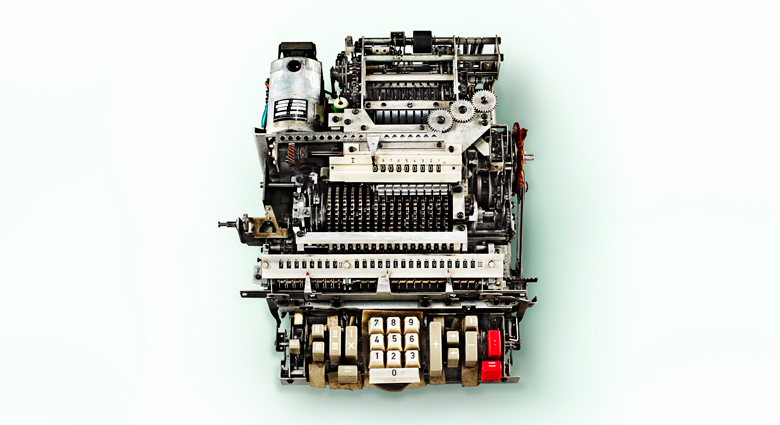
Interesting photos of mechanical calculators from the 1960s at Kevin Twomey’s web site. Here’s a sample:

There’s also a pretty cool, short video about the guy who is collecting these.

The lengths we went through to do math — even simple add and subtract — was amazing. The side views are particularly cool. There must be thousands of gears, levers and switches that make these things work. In the video he said that one of these machines could cost upwards of a $1000 in 1960s dollars (around $7000 today) and these were the pinnacle of technology at the time.

The collection belongs to Mark Glusker, who actually has even more information on his own web site. One of the things I find interesting about these machines is the button locations. On electronic pocket calculators that layout was standardized. But in the mechanical calculator days there was a ton of experimentation.

The iPad, by comparison, can do a lot more with a lot less parts. Of course try fixing an iPad yourself. You can’t. But if you were mechanically inclined you can easily fix one of these calculators.

Frighteningly Ambitious Startup Ideas

Paul Graham wrote this very interesting post a week or so ago about ridiculously hard startup ideas:

One of the more surprising things I’ve noticed while working on Y Combinator is how frightening the most ambitious startup ideas are. In this essay I’m going to demonstrate this phenomenon by describing some. Any one of them could make you a billionaire. That might sound like an attractive prospect, and yet when I describe these ideas you may notice you find yourself shrinking away from them.

Don’t worry, it’s not a sign of weakness. Arguably it’s a sign of sanity. The biggest startup ideas are terrifying. And not just because they’d be a lot of work. The biggest ideas seem to threaten your identity: you wonder if you’d have enough ambition to carry them through.

The weird thing is I didn’t blanch at any of the first five (I have no experience to blanch or not blanch at the last couple). In fact, I have given serious thought to the second one and even have a product idea for carving off a slice of the email market. Honestly, I’m mostly interested in big, world changing ideas and don’t generally see the point of small ones.

I guess this means I’m insane? I’m sure there are a few of you out there who know me nodding in agreement about now.

Could Apple Announce iPhoto for iPad and Enhanced PhotoStream This Week?

A week and a half ago I wrote about how my biggest wish for iPad 3 is writing support. Through MG Siegler‘s blog I noticed an article by Neven Mrgan regarding better iPhoto support. John Gruber and Dan Benjamin also speculated on the topic in last week’s Talk Show.

First things first, it is unlikely that there will be enough to talk about, hardware-wise, to make iPad a launch unto itself. Something else has to be shown on stage and usually, as Gruber pointed out, it is software. So I like the idea of iPhoto for iPad being released at the same time as the iPad 3. (The other rumor floating around is a refreshed Apple TV but I doubt this would be a big focus unless Apple announces an Apple TV App Store.)

The question in the room, at least when it comes to iPhoto, is Photo Stream. As Mrgan comments, “Photo Stream is neat, but it’s not what everyone wants: it’s not cloud-based storage for all your photos, mirrored across all your devices.”

He’s right. Without the PhotoStream enhancements an iPad version of iPhoto is less useful. (Not useless, just less useful.) Personally, I’d like to see this improvement to PhotoStream. I want my photos and video accessible everywhere. I’d like to be able to mark certain photos as staying on the device and let others be accessible but live in the cloud. I’d like those photos in the cloud to sync with my local repository in iPhoto on my desktop. I’d like to be able to embed those videos and photos in blogs and other sites without having to download, copy, upload, etc. I’d even be willing to pay extra each year for such a service.

I find Apple’s occasional announcements to be a ton of fun and almost enjoy the speculation of what they will announce as much as the announcements themselves. So few companies in the tech space keep that mystery. I wish more did.