Upgrading Sucks

I finally got a chance to upgrade my desktop operating system to OS X Mountain Lion yesterday. And of course I have devices to upgrade to iOS 6 this week, too, although one OS per day is more than enough. Every time I update the OS I remember what a pain it is and why I miss the days when I only had to go through this pain once every five years or so. Given that, this upgrade doesn’t seem to be as bad as the Snow Leopard to Lion upgrade, where it took me weeks to figure out how to scroll correctly. This time my biggest complaint is that Apple defaulted a calendar preference that now means I will be constantly alerted to every all day event I have scheduled. For the record, none of my all day events — and I have lots of them — had alarms before this.

On top of these OS changes, I’ve also been steadily updating my development skills. I’ve been exploring new features in iOS, learning OS X, and getting up to speed on the latest changes to Rails as well. My code for iOS in particular is so much better than it was even a few months ago and the changes Apple has made to the compiler are really nice. At the same time, massive changes to the way things are done. The older I get, the more stuck in my ways, the less I want to completely re-think the way I am writing code every year.

Upgrading isn’t easy, and I say that knowing full well that Apple’s iOS and OS X upgrades are about as painless as I could possibly expect. It would stink if technology stayed still. After all, we have a long way to go with this technology before it can stop changing. On the other hand, it would be nice if things didn’t change quite so often.

I’ve got whiplash.

Expanding the Mobile OS Scrum: Here Comes Firefox OS

Mozilla is working on a mobile operating system they call Firefox OS. Its CTO, Brendan Eich, had this to say to TechWeek Europe:

We see an opportunity to serve users by converting them from feature phones to inexpensive smartphones. The action is in the emerging market, not going up against the top end of the market in the US, where Android is chasing Apple.

Smart strategy. If Mozilla is successful with a new mobile operating system it sure is not going to be by going up against Apple, who controls the high end of the market. And it sure wouldn’t be the last time a low-end disruptor was disrupted on the low-end. A low-end disruptor forced to the middle might as well be no where because there is no mid-market.

Android licensees now have to worry about paying Apple and Microsoft royalties, have to compete against a Google-owned Motorola, and apparently have to worry about being kicked out of the open alliance for using an Android OS knock-off for other devices. So maybe Mozilla, unlike Palm’s webOS and Microsoft’s Windows Phone and Nokia’s Symbian and RIM’s BlackBerry OS, is in the right place at the right time?

Maybe. Although Firefox OS could get sued by Apple and its licensees have to pay royalties to Microsoft, so who really knows what the net impact will be. All I know for certain is that every time we shrink an OS maker in this market, we seem to also add one back to the scrum.

[via Parislemon]

What Comes First, Users or Business Model?

Bloomberg Businessweek had an interesting article on ESPN in the September 3 edition. In it the WatchESPN app and ESPN’s mobile strategy was discussed. WatchESPN allows cable subscribers to watch ESPN programs at their leisure, including sporting events. For ESPN, though, many of the programs aren’t showing ads yet since those rights weren’t sold with the television rights. As the article says:

In other words, ESPN has invested in creating content for a platform before business exists to support it. John Kosner, executive vice president for digital and print media, says, ‘We weren’t afraid of cannibalizing our [television] business if the fan liked it … even though the ad-serving technology just isn’t ready yet. We’re not afraid to be ahead of the market. You win by delivering what fans want, and then that becomes a fantastic advertising proposition and a great business.’

Apparently the fans don’t like WatchESPN. When I looked this weekend the app had a two-star rating. Many of the reviews were primarily business model stuff, like let me buy a subscription. I get the sense that ESPN could be the first to move in this direction, if their always cannibalizing street cred is real.

While there is tons of talk of HBO and Game of Thrones program in the tech press, it is ESPN and live sports that is the last thing keeping people tethered to cable. Luckily for me, the sport I prefer (baseball) and the team I follow (Cleveland Indians) are available on MLB.tv. Playoffs are a problem, of course, but the Indians haven’t been good enough lately to have to worry about that.

Another thing that I found interesting about this quote is that ESPN specifically chose to release an app before securing a business model. This seems like a catch-22 proposition. For something that hasn’t been available before, finding out whether people will use it and what they are doing with it is important. Without knowing that information, it is hard to figure out what and how to charge. Without charging, though, we don’t know if there is a business at all and thus makes all those users a moot point. Seems like a classic chicken and egg problem.

Why The New iPod Nano Is Interesting

Of all the things that Apple announced last week the one I can’t get out of my head is the iPod nano. It is by far the least consequential of all the products updated. iPod sales are falling off quickly as more people carry phones that can play music. The iPod classic and iPod shuffle haven’t been changed in years and it seems like the iPod touch only gets updated to keep it in line with the iPhone. And yet, as John Gruber and Om Malik pointed out on last week’s The Talk Show, the nano shared the stage with Apple’s most consequential product, the iPhone.

But is it really inconsequential? Or is Apple giving us a hint of the future?

First, let me lay out the current situation when it comes to Apple’s new devices and pricing. The iPhone 5 ranges in price from $449 to $649 without a contract (after November 8). The iPod touch is either $299 or $399 and the iPod nano is $149. Let’s line that up:

  • iPhone 5 with 64GB: $649
  • iPhone 5 with 32GB: $549
  • iPhone 5 with 16GB: $449
  • iPod touch with 64GB: $399
  • iPod touch with 32GB: $299
  • iPod nano: $149

No price overlap, a perfect pricing umbrella.

But these products aren’t connected, you say? The iPhone 5 does a lot more than the iPod touch which does a lot more than the iPod nano. But is that really true, in particular between the iPod touch and iPhone? Once upon a time these were very different devices. The iPod screen stunk, the camera was mediocre, the processor was slow. Now? The iPod touch, especially to the average consumer, is basically the same as an iPhone from a hardware perspective. So what’s the difference? The only difference is that the iPod touch is wifi only and the iPhone has a cellular chip. Over wifi the iPod touch can make phone calls (Skype and FaceTime), send messages, whatever. In other words, Apple could easily reconfigure this part of the product line to look a lot like the iPad, dropping the iPod touch name altogether:

  • iPhone 5 with wifi & LTE, 64GB: $649
  • iPhone 5 with wifi & LTE, 32GB: $549
  • iPhone 5 with wifi & LTE, 16GB: $449
  • iPhone 5 with wifi only, 64GB: $399
  • iPhone 5 with wifi only, 32GB: $299

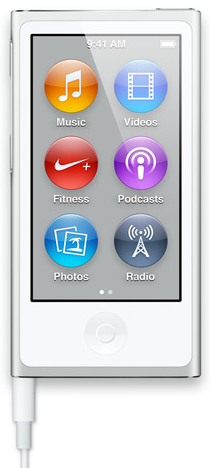
What about the nano? It doesn’t even run iOS. But look at the thing:


If you didn’t know it didn’t run iOS, you’d have no idea. Apple went out of their way to change the iPod nano, a device whose sales are most likely falling off, to look an awful lot like an iPhone or iPod touch even though it isn’t. It is even multi-touch capable. Could the next generation run iOS, handle entry via voice, and offer cellular calling?

Apple today uses various generations of iPhones to cover a wide umbrella of price points. I am speculating that Apple, in the future, could use three different devices to do the same thing they do today. At the high-end, a pro 4″ screened device, at the mid-tier a classic 3.5″ screened device, and at the low end a nano 2.5″ screened device. Instead of each device coming with a cellular chip, 3G/LTE would be optional just like on the iPad. The iPod line goes away and Apple ends up with an iPhone pro, iPhone classic and iPhone nano filling in the product line.

  • iPhone pro (64GB): $649
  • iPhone pro (32GB): $549
  • iPhone pro (16GB): $449
  • iPhone classic (64GB): $399
  • iPhone classic (32GB): $299
  • iPhone nano: $149

I like straight lines and simplistic presentation, just like Apple. The current line-up is confusing at best and it seems to me that the differences between iPhone, iPod touch and iPod nano are quietly blurring. A future where cellular technology is optional — just like the iPad — seems like a safe bet. If this happens, I’d expect it two years from now.
Stuff I’ve Bought

I seem to be buying a lot of technology products lately. Here’s what I’ve bought and why:

  • iPad (retina, 3rd generation)
  • Samsung Galaxy SII
  • Samsung Galaxy Tab 10″
  • Nexus 7
  • Roku 2 XD
  • Kindle Paperwhite
  • Apple iPod touch 32GB (5th generation)

The problem with being a programmer is that I am constantly buying devices. The two Samsung devices and the Nexus were specifically to test our new Android version of powerOne, for instance. For Android this “buying devices to test on” thing is a never ending battle. There are way more devices then I could possibly own. For the most part, these three devices sit on a shelf. I pick them up periodically to play around, although the Galaxy SII also serves as the old Infinity Softworks phone line. Of these three, the Nexus 7 is probably my favorite. If I didn’t have so much of my world already geared to work seamlessly with iOS, I could see using this more often at least as a reading device for blogs and basic web browsing. It’s too small to use for note-taking or any sort of long form typing, though, which is the other thing I do with my iPad.

Speaking of iPad, yes the iPad was a long ago purchase, way back in April when it came out. Of all the devices I’ve received so far it is my favorite. I use it hourly and generally is the first thing I grab in the morning and the last thing to get tucked away at night. The display is amazing. I recently had to do some testing on the second generation iPad. I forgot how much better the retina display is. I like smartphones but the technology I’ve waited my whole life for is definitely the iPad.

Roku is a device like Apple TV. I hooked it up to the television and it lets me watch movies, tv shows and stuff like that, streamed rather than live television. There’s a lot of crossover functionality with the Apple TV, which is the one I use most the time as it streams my personal content as well as has Netflix and MLB.tv. I probably wouldn’t have bought a Roku again but we added Amazon Prime after we canceled cable and needed some method to watch its content. Apple TV does not offer an Amazon Prime app yet. I’m still hopeful Apple will open that device for development soon.

The two recent purchases, neither of which I’ve received yet, is the Kindle and iPod. As mentioned before we need devices to test on. Apple and Google give us simulators, replicas of these devices that run on a Mac or PC, but they aren’t exactly the same. Speed is different, there can be differences in how the UI handles, and it is really hard to get the feel for how a device reacts to a finger press without the device itself. We usually try to collect one of each generation of Apple hardware. We have iPhone 3Gs, 4 and 4s, iPod touch 4th and 5th generation, and iPad 1, 2, and 3. The 5th generation iPod lets us test for the taller 4″ screen.

Probably the device I am most excited about getting is the Kindle Paperwhite. While owning a Kindle has allowed me to read more fiction than I have in years, I found the current model, Kindle Touch, a little too dark compared to paper and don’t like to carry and attach a light. At the same time, I don’t like using my iPad for reading at night since the light glows in my face and keeps me awake. The Paperwhite is supposed to fix this as it is not backlight but has lighting all the same. For $120 I’ll find out.

Conspicuously missing is the iPhone 5. I have concerns about my personal use of this device. For one, I want my phone to be smaller, not larger, and I have some concerns about the iPhone 5’s taller screen. I think I’d like to see one before buying. Now this would have been a moot point if I qualified for a discount right now, but for some reason we don’t until December. For $200 I would buy one sight unseen; for $600 I can wait.