Kindle Paperwhite

I’ve had the Amazon Kindle Paperwhite for about a week now and have used it every day. As background, my first Kindle was the Kindle Touch released last year. I found it to be deficient in two significant ways: 1) its touch interface was not very responsive and 2) in order to read in even a shaded room I needed an external light.

On last year’s Touch model the responsiveness of the user interface was horrible, even after the update. It was typical to tap the screen and have it not react for multiple seconds. Often times I would tap a second time thinking I didn’t hit it correctly and then it would do whatever I asked, like flip the page, twice.

The need for a light, even when the room was just a little dark, was another pet peeve. Not only did I have to carry an external light with me, but I would have to attach this clunky thing that always got in the way of the screen (shadows or the light’s arm) in some way. The light, by the way, had two settings: bright and blaring. I read a lot in bed at 3am, trying to clear my head so I can fall back to sleep. My goal is to not wake my wife. I couldn’t make the old light dim enough.

Amazon pushed the Touches e-ink display as a replacement for paper but it really wasn’t. In every way — resolution to coloring — that e-ink display was pretty mediocre. Speaking of color, the e-ink displays were significantly darker than paper so reading in a room with a little natural light but not a direct light on the screen made the e-ink impossible to read even when paper was readable.

I can report in every way that the Paperwhite is superior to the previous Touch model. It is very responsive to screen taps, for one. I no longer am left wondering whether my selection registered or not. Furthermore, the screen with lighting on is excellent. It solves all of the problems I had with the previous model (while introducing one nitpick). The controls are quickly available and it is easy enough to turn the screen down to its lowest settings.

At the low end, the screen replicates the color of paper much closer. And with a simple adjustment, making the light brighter by just a few notches, I get plenty of light to read at 3am without disturbing my wife sleeping next to me. We are both a lot happier!

My nitpick is that the backlighting leaves a slight shadow at the bottom of the screen. At first I noticed it readily but after a few days it faded into the background.

The Paperwhite is much closer to my ideal reading device than the Touch was. I’m quite happy to have paid the $119.
Little Money For App Developers

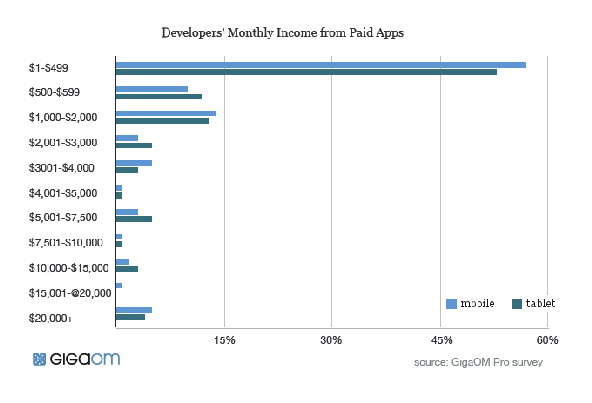
Some sad data from Giga Om on what app developers are making.

More than 50% earn less than $500 per month and about 80% earn less than $2000 per month. Apparently advertising-based apps do even worse, where 1/3 make less than $100 per month. The split isn’t totally unexpected but $20,000 per month in revenues isn’t really that much. That probably pays 2 or 3 people market wages in this industry.

I couldn’t find a number readily but I’d estimate there have been somewhere north of 400 million smartphones and tablets sold in the past five years. Through 1986 there were about 40 million personal computers sold. By December 31, 1986, Apple Computers, Microsoft, Adobe and Oracle, all of whom built themselves specifically in the PC era, were all public. It doesn’t strike me that there are any mobile-specific companies, with 10 times the devices sold, in the same position today.


In The Transition

Fred Wilson is running a Monday series on sustaining business. I think this is very important. Young entrepreneurs need to understand that you can indeed run a business for a long time and that can be a good thing. I think we over-glorify quick wins and fast growth in the tech community. Here is Fred’s first and second posts on the topic. In the second, Fred talks about the transition as market conditions change:

A company that I’ve worked with for more than a decade saw the industry it services go through some painful transitions in the 2008/2009 downturn. They built an entirely new line of products that service the growth part of the industry while working to maintain the older products through an orderly and gradual decline. It’s been a difficult transition because it has meant that the company’s top line hasn’t grown during this transition. But the company is still in business and the new products are growing quite nicely.

We are in a similar boat here at Infinity Softworks. We too are transitioning — or at least we hope we are — from powerOne calculator to a new product we hope to formally announce in the next few months. It’s not that powerOne will go away. We hope to maintain and improve it for years to come and are even working on an Android version as we speak. But we are hoping the new product will supply the revenue growth we desperately need and that powerOne has not provided. Here was my addition to Fred’s post:

I’ve run my software company I started in college for 16 years. It hasn’t been on purpose. It just so happens that I have a vision that has yet to be satisfied and I keep trying to achieve that vision.

The last few years have been brutal as the market (mobile computing) completely collapsed then re-birthed from the ashes. Our successes were built on partnerships and in the re-birth, first those relationships became harder because control of the industry moved to carriers and then the software side was completely (I don’t have the right word) gutted by [the App Store]. It’s not possible to sell [our] software the way we used to and at the sustainable prices we used to.

I’ve spent the past few years trying everything with the old products to make them sustainable again, everything from different business models to different partnership strategies to different product mixes. All we wanted to do was give us a baseline so we could focus on new ideas to achieve that vision. We have never been able to do that. But we have a unique new perspective and pursuing it fully. I said to myself that if this crashes and burns I’d rather do it making the transition then trying to revive the old, although the gravity of the old product is very strong and powerful.

Two lessons as we attempt this that Fred doesn’t mention here but are critical. 1) We may not be able to take the old customers with us. This is very hard because we owe these customers a lot and these customers LOVE our products, literally carried decade-old PalmPilots to use it. They are a huge pull. But the market has changed and the old product doesn’t work anymore from a revenue/business model perspective. Old customers are a glorious and horrible trap [1]. Learning from them without giving in to their wishes of a better old product is extremely hard.

2) The worst part of making the transition is the psychology. It is hard to explain. It is part grieving process as we deal with old successes dying. It is part fear as we have no idea what we are getting ourselves into. It is part sadness as we said goodbye to 90% of the team that got us success in the first place. It is part bull-headed-ness, obstinance and wanting to spit in the face of everyone who wrote us off. But most of all it is excitement for what the future holds about doing something different that might finally achieve the vision we set out all those years ago and have yet to achieve.

At this stage of the game, the lows are really low and the highs are really high, and the true believers are few and far between.

It’s not like we will abandon powerOne. It’s a great product that satisfies a need for many of my beloved customers. And I do believe there are a contingent of powerOne customers who will absolutely love the new stuff we are working on. I hope to make true believers of more of them soon.

[1] I mean this as a term of endearment, not in any negative way. Customers know what they know, and they know powerOne and want more of it. As an inventor I can’t rely on my customers to see the next thing until I present it to them, and even then they may not get it.

Business In A Bubble

I want to relay a theory I have about starting a business but in order to do so I want you to envision something: a person in a translucent bubble. The person is right in the middle, somehow floating there, able to see in all directions (at least to some degree). That’s the start-up.

In order to grow the business the person in the bubble needs to push as hard as it can on a spot in the bubble. It doesn’t move easily nor does it expand easily. One person can only push so hard, two people can push a little better, but adding too many people into the bubble means no one can move or push as there are too many people in there. The goal at this stage is to move the bubble and at some point grow the bubble so more people can push it in the right direction.

The beauty of the bubble is that it can go in any direction at this stage. It is standing still and any path might be the right one.

So I was thinking about the magazine and newspaper industry this morning and thinking that this is an industry that has too many people in the bubble and their momentum has carried them down the wrong path. Now, they are trying to reverse course, move in a new direction, and in many cases trying to do it with all these people.

Another problem for the industry though is that their backs are against the wall. I take this analogy quite literally — the bubble is pushed up against a wall. That limits the directions the business can go, hemming them in.

One final thought: better to burst your own bubble then let someone else do it. Better to force a change in direction before your back is against the wall.

An Interview With a Comic

I’m smitten with the comics and writing of Randall Munroe. I read both his xkcd.com comic strip and his Tuesday What If? series with regularity. He is a very smart guy who uses his nerd humor to good effect. There’s a great interview with him in The Atlantic that is well worth a read, and even provides some interesting nuggets of insight for every company, including this one on why he chose to structure his site for one strip at a time reading:

One of the things I’ve learned with doing xkcd is that you sort of give people, “Here’s the thing, and here’s the button you can press to get another thing.” Sometimes that can be more easy to digest than “here’s a long page of things.” You can read through it, and you get to the end and think, “Wow, I just read a whole bunch. Do I really want another page like this?”

I hope you’ll take the time to read it.