Overcoming Ignorance: The Search For Good News Sources

I have been struggling for a while with how to find and discover the daily news. I don’t read all of it in depth but every evening I like to flip through the headlines, read a few articles, and at least get a sense of what happened that day. Each day I like to see what is happening in world and US news, local Portland news, technology/business, and sports.

Local and tech news are pretty much taken care of. I get feeds of local news and tech news and follow along throughout the day. In the evening, then, I usually review Hacker News and Techmeme as well, which gives me plenty of long and short form technology information. For business insight, I read Bloomberg BusinessWeek. While this doesn’t give me the daily insight into what’s happening in the business world, it does give me some sense of topics.

Sports and world/US news have been a problem. I’ve tried a number of different solutions. For sports I currently peruse ESPN’s mobile app each day. The news there is lacking, though. Too much opinion and too little news. Furthermore, I can’t figure out how they decide the order of stories. I get a “timeline” with some times for today and some from days ago. I haven’t found anything else so far on this topic.

World/US news is more important to me then sports news and here I have failed multiple times. I have tried a few of the newspaper apps, including USA Today, NPR, Wall Street Journal and New York Times. I’ve stuck with the New York Times the longest even though I find its front page news often missing important stories in favor of New York news. I hate to break it to you, New York Times, but I could care less about your human interest stories about NYC and doubt many people outside of the city do either. It’s hard to consider you a national paper when you are so NYC-centric.

I’ve been using a few others recently that have promise. One is The Evening Edition. The stories are summarized and straight forward with lots of links for more depth. It has much more of an international flair than anything else I’ve been reading. It’s a great resource but just too short. Five stories and four links just isn’t enough to summarize the day.

Last night, though, I downloaded a new app that has promise. The app is named Circa. It starts with a list of headlines. When you click on any one, it gives you summarized information in small snippets, allowing the reader to dig deeper into the story, both as snippets and links to the original posts. It was just the first night but I found myself reading more stories then I have in a while, easily able to catch up on some multi-day old stories that no one else reported the aftermath of or new stories I hadn’t seen before.

Whether Circa is the answer or not I don’t know yet as it is too early. I accept the fact that my news may not come from a single source, just like it is for tech news, and that’s fine. But someone has to figure out how to present the news in a logical way for mobile. I hope someone does soon because I’m dying to be better informed but feel as ignorant as ever.
The Forgotten Social Web May Not Be So Forgotten

Alexis Madrigal had a very interesting article in The Atlantic last Friday. In his article he talks about there really being two social “networks,” one is the one that gets all the hype, led by Facebook and Twitter, and the other is what he dubs “dark social” networks, or those that can’t be tracked. Included is email, instant messages and the like. It turns out that 57% of The Atlantic’s traffic and 70% across Chartbeat’s media partner sites are referrals via dark social media. Chartbeat is the company tracking data for The Atlantic and others.

If you think optimizing your Facebook page and Tweets is “optimizing for social,” you’re only halfway (or maybe 30 percent) correct. The only real way to optimize for social spread is in the nature of the content itself. There’s no way to game email or people’s instant messages. There’s no power users you can contact. There’s no algorithms to understand. This is pure social, uncut.

So the social web (web 2.0) revolution didn’t create social, as Alexis points out, instead it structured it and made it trackable.

We optimized powerOne to share via email. While we technically have the ability to know how much it is used we aren’t tracking that data. It would be interesting to know. Furthermore, and again under the heading of “can’t possibly know,” it would be interesting to know how much of powerOne’s success has come from one person showing another person the app. I hear from customers all the time who say they tell everyone they know about the app. Given the amount of conversation on Twitter about it, email and word of mouth has got to be huge.

Why Vision Is Critical

I spent six and a half years in undergraduate and graduate business school and I can tell you, without a doubt, that the worst taught topic was company vision. It’s clear, in retrospect, that not a single professor I had truly understood it (or at least could explain it in a way I could grasp).

Fred Wilson has a new sustainability post this morning, in which he shared a video of Dennis Crowley, founder and CEO of Foursquare, talking about the time when Facebook announced Facebook Places, Google announced Google Places, and everyone was competing with tiny Foursquare:

Fred goes on to point out that this is why we need a corporate vision. That vision keeps the company on the straight and narrow, focuses it on the long-term success of the business, not a short term roadblock.

Here’s what happens: small company starts to gain some traction, big company realizes it is something they should be doing and makes a build versus buy decision. If they decide to build the technology, whether that’s because small company rebuffs big company or because big company decides just to build their own, little company now feels overwhelmed by the competition.

But here’s the thing: big company has not thought about the problem for years, lived with it and experienced it first-hand. Big company is a mercenary, bent on getting into the space because they think they need to. Small company, meanwhile, lives and breaths this problem every day, talks to customers who live and breath this problem every day. And that’s the competitive advantage: the small company’s ability to solve the problem better than big company.

A vision is critical. Without it, the company gets waylaid by every distraction, every competitor, every decision point. And as for the CEO, if she doesn’t feel it in her gut, live and die by that vision, then the company will never make it.

The Next Frontier: Digital Tickets

Apparently, MLB rolled out its Apple Passbook experience the last couple of weeks of the season:

In the two weeks that the Passbook program was in place at four Major League ballparks, Passbook accounted for 12% of sales of single game tickets purchased online, around 1,500 in total. Those numbers seem pretty darn impressive, the parks are not minor ones, and that’s a decent chunk of ticketing. But they get even more impressive when you think about the breakdown.

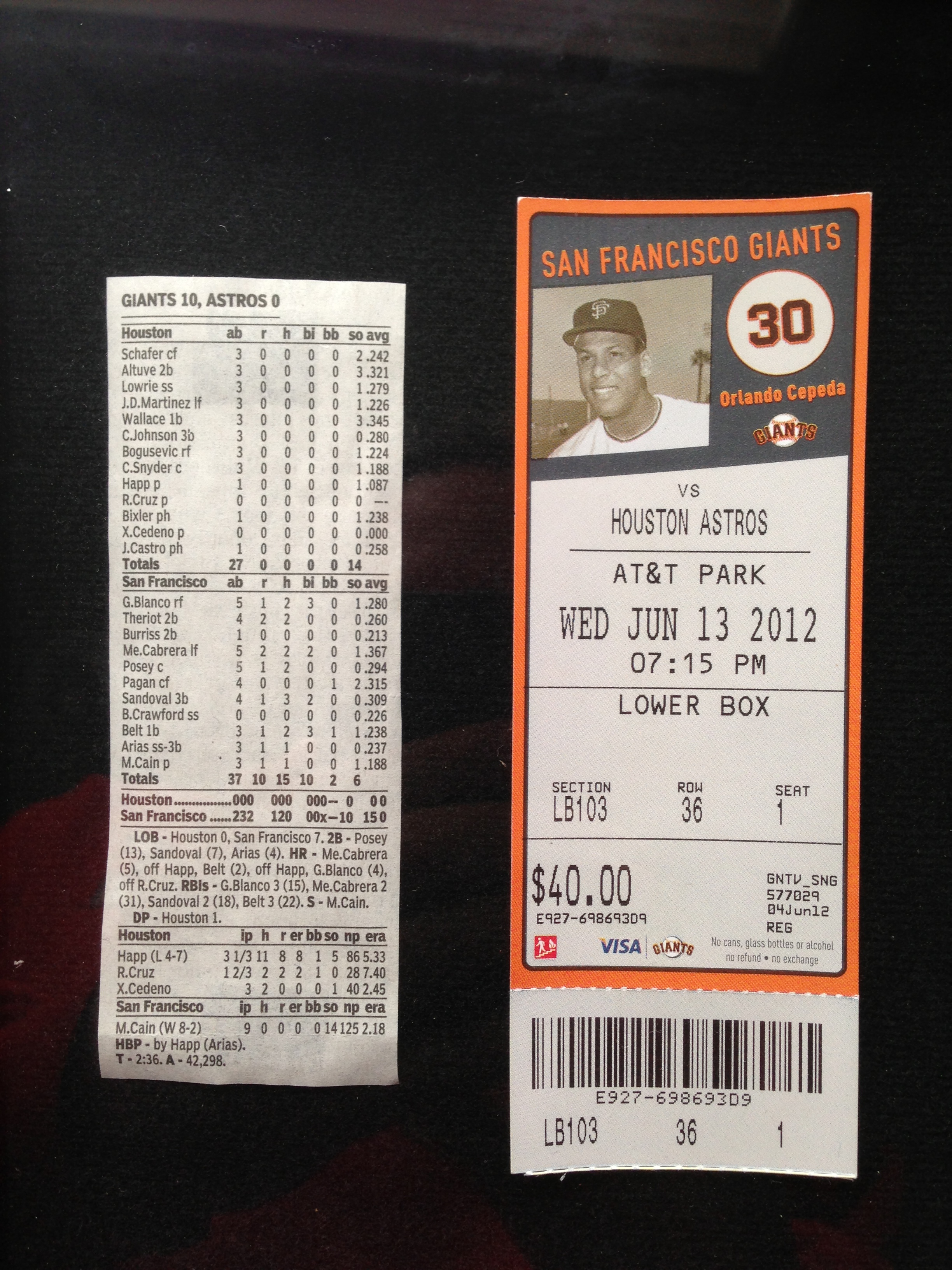
I have a box in my closet filled with ticket stubs for every event my wife and I have ever been to. That’s more than 17 years of movies, concerts, ball games, etc. Normally I’m a big digital guy as I hate the clutter and dust. But what happens to my shoe box when there are no more ticket stubs?

The picture is my MLB ticket stub and box score from Matt Cain’s perfect game this summer.

powerOne Calculator for Android Beta Now Available

I’m excited to announce that we released today the first alpha version of powerOne calculator. You are welcome to download and try it here. The first release includes bundled templates and a full working algebraic and RPN calculator. We will be adding template creation, Library access and more soon.

Please keep in mind that this is pre-release software which means it is feature incomplete and buggy. If you’d like to assist us in finding bugs, we’d love your help!