2012: Ending the Gatekeepers

Over at avc.com, Fred Wilson commented that he thinks 2012 will be the year that the movement goes mainstream. He sees five events — Ron Paul’s rise in popularity, Occupy Wall Street, Reddit as an populist building community and a couple of technology things —  as setting us down this course.

While I agree with Fred, I latched on to a comment by Lucas Wilk:

It all ties in with the big theme, the megatrend as you will, which is the end of gatekeeping of just about any kind. Legacy structures based on keeping the information flow from top to bottom are being made obsolete in the areas of broadcasting, publishing, commerce and now mass communications . The world is clearly becoming more horizontal and rapidly decentralized. [italics mine]

I’ve been staring this trend in the face for the past year and have been unable to put a definition around it. I’ve been calling it “when the app comes to you.” In short, our world is changing from one where we go to an app to get things done to one where the app comes to us. In the old days to send an email we would launch an email application, wait for it to appear on the screen, type in the name, subject and body and send it. Now I click a link in an app or web site and an email client launches right within the application I am working within. No switching apps, no splash screens. I do my business and move on.

There have been a number of technologies and apps that have made this “app come to you” possible. To save something to Evernote, I choose an icon on the menu bar of my Mac. To post a tweet to Twitter or save an article to Instapaper, I just choose that option in any number of apps I have on my phone or iPad. To read my articles every day, I don’t go to 200 different web sites. I grab them all in one central location using RSS. Even the web, using technologies like WebKit, now appear in my app explicitly instead of me going to a browser. Siri is just the most recent example of this. Ask it for something and it will try to take care of it, interacting with any number of web sites, apps and services to get that done.

Except calling it “when the app comes to you” isn’t particularly elegant and doesn’t encapsulate what I am seeing. What this really is is the end of gatekeeping. We now expect to interact wherever we are, in whatever context we choose. And that applies for everything: software, hardware, politics, learning, entertainment, sports. You name it we want the gatekeepers banished.

2012 is just the beginning of this movement. But Fred is right. This is the year for it to go mainstream.
To Android or Not To Android

There has been a lot of hubbub this week around Eric Schmidt’s Android comments. Eric, the chairman of Google, said at LeWeb that “whether you like [Android] or not, and again I like it a great deal, you will want to develop for that platform, and perhaps even first.” He set a six-month time horizon for this Android-first change. Android has a lot going for it, that is for sure. Its smartphone “market share” is over 50% and clearly many customers prefer Android over other platforms.

Marco Arment, the creator of Instapaper (an iOS, web and Kindle app), asked why anything would change in the next six months? Developers aren’t making money on Android right now (link). Gene Muster from analyst Piper Jaffray backs up Marco’s assessment. He claims that Apple has sent $3.5 billion to developers while Google has paid out $240 million (link). That’s a huge difference. The folks at Shifty Jelly, an iOS and Android developer, have had the opposite effect, though. Their Android sales far outweigh their iOS sales (link).

“Market Share”?

I put “market share” in quotes before. Why? Because market share numbers to developers is completely different than how most consumers view the popularly reported figures.

As others have pointed out before me, we can’t really compare Android market share to iPhone market share. That is a platform versus a device. As a developer we generally write for a platform. To compare apples to androids, we would need to count iPhone, iPad and iPod touch market share, combined called iOS market share, to Android market share. And given Apple’s commanding lead on the iPad and the number of iPod touch devices sold, that number favors Apple. According to comScore, Apple’s US market share as of August 2011 is 43% to 34% (source). Worldwide as of October 2011, according to Net Applications, Apple is favored 61% to 19% (source).

A Touch of Accounting

This comparison comes into even sharper contrast, favoring Apple, when you realize that Android (and all other mobile device) sales are counted completely different than Apple sales. Apple’s sales are counted as the actual sales to a customer. I walk into a store, buy an iPad and Apple adds a 1 in the sales column. Android’s (and other mobile device’s) sales are counted as sales to channel.

The difference is huge. A sale to channel is a sale to Verizon or Best Buy, not a sale to a customer. Samsung, HTC, Motorola, RIM, and Nokia all get to count the sale into the channel as revenue and as a sale toward market share [1]. But it doesn’t mean that device was sold to the public. RIM just showed why the two — iOS market share and other operating system market share — aren’t equivalent as it is taking a write-down (meaning the channel sent back devices) of $485 million and possibly as many as 2.4 million devices (link). RIM, when figuring BlackBerry/QNX operating market share, got to count those 2.4 million devices toward their share.

I only care about devices sold to customers.

If Market Share Really Mattered…

Even if you think I am full of it and don’t believe the numbers from above, then why are many developers focusing on iOS over other platforms with much greater penetration? John Gruber points out, for instance, that Windows and the web have much larger installed bases than Android and iOS combined. If market share matters so much, why do developers ignore the web and Windows, choosing to develop exclusive for iOS, Android, RIM or a combination of these “low market share” devices (link)?

The real answer, which John misses, is they don’t and you can’t, at least when it comes to the web [correction: I mean Internet so I might not actually disagree with John]. The hottest applications of 2011 are all web-connected applications. Instagram was just named Apple’s app of 2011 (link). The year before, I believe, it was Flipboard. Neither app works without the web. Both require a web connection to share images and gather stories with your network. Just because the front-end isn’t in a browser doesn’t make them less of a web application. Neither of these apps could have existed before the web, even on a desktop computer.

If you want to create a highly successful mobile app today, I believe, you better figure out how the device and web work together.

I’m No Idealogue

Look, I’m not an Apple fanboy nor am I an Android one. My allegiance is to the platform(s) that pay the bills. For that matter I write apps that work with numbers and have made a living at it (sometimes just barely) on multiple platforms for 14 years now (link to powerOne). I do put a lot of stock in the numbers and so far they are telling me that for an app like powerOne, one that relies on customers paying me $4.99 per copy, and for a team like we have, which is too small to focus on many platforms, that iOS — iPhone, iPad and iPod touch — is still the primary game in town.

[1] Amazon Kindle Fire sales are most likely counted like Apple sales since they are sold directly to customers. I’m not certain how Barnes and Noble accounts for Nook sales.

Get Mad.

I’m disgusted. I’m disgusted with our government being more concerned about protecting its big donors than making this a country we can all be proud of. We have had this fight over PIPA and SOPA (a great video here that explains it all), two privacy bills that would let the government shut down YouTube, Facebook and other web sites when a third-party posts copyrighted material. Makes me want to go BitTorrent all my movies rather than pay for them.

And then this report hits Bloomberg two days ago that I am seeing in none of the media. The report says that the banks didn’t get bailed out to the tune of $700 billion as the government said it did. It got bailed out to the tune of $8 TRILLION with below market loans. What did the banks do with it? Turn it into a $13 billion profit, by the way, not to mention pay themselves exorbitant bonuses for their “good work.”

Every day passes and every day feels more like we are participating in the great American con job. Nothing to see here, our government says.

There is a revolt that is going to happen here sooner or later. Throughout history this country has never stood long for this lunacy. When the gap between rich and poor, the gap between better off and less-to-do, becomes wide enough, the tendons that bind this country together snap and a third-party rises from the ashes to correct the wrongs.

This one, Democrats and Republicans, isn’t going to go away.

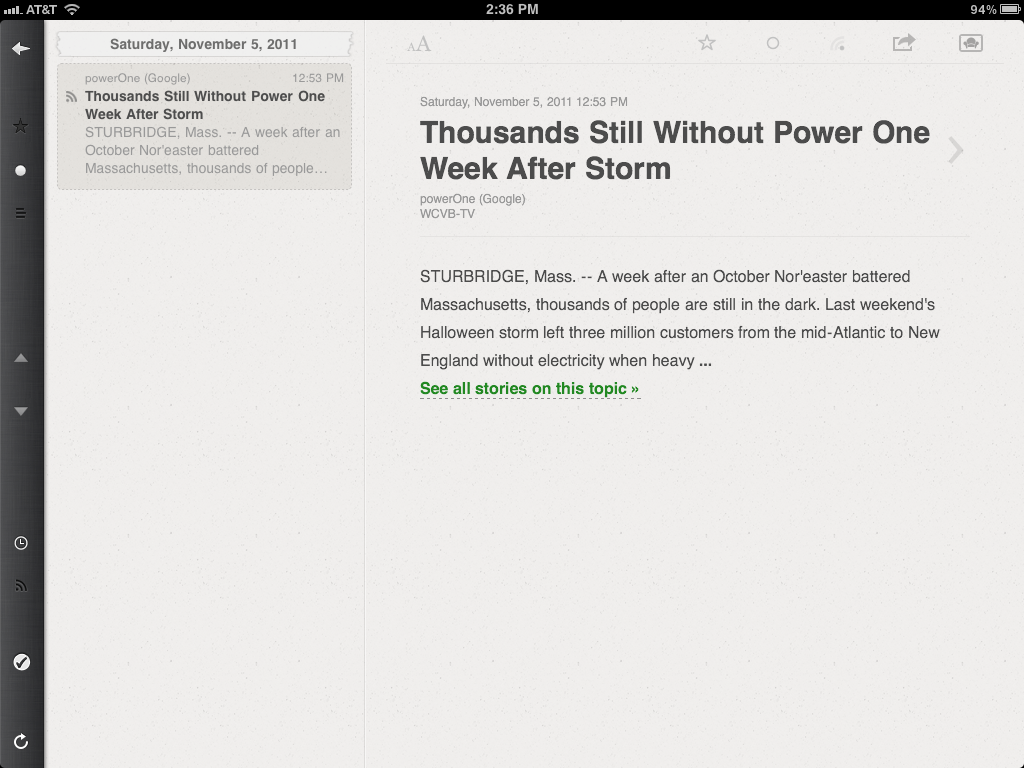
Storm Victims Missing Their powerOne Calculator

Oh the humanity! Thousands without my powerOne calculator a week after the storm!

I monitor instances of “powerOne” all over the web with some tools that Google provides. It is neat to see what people are saying and who else is using the term “powerOne.” Sometimes, though, it will catch two words that are close in proximity and Google will show that post to me. In early November the above post was waiting for me one morning when I opened my Google Reader app on my iPad (an app called Reeder).

Obviously not funny for those without power. But if read slightly different…

Obsession Times Voice: Take-Aways

I finally had a chance to listen to Merlin Mann’s and John Gruber’s excellent presentation at SXSW from 2009 called Obsession Times Voice. Their thesis is that a deep knowledge on a specific topic gives you a unique voice and ability to attract like-minded people. The presentation was aimed at bloggers but I found the advice very pertinent to start-up software companies as well. A key take-away was some advice Mann gave to a young blogger via email:

1. Give away more stuff than you think you should and make it easy for people to get.
2. Focus on diverse … revenue streams and always have your eyes open for new and replacement ones.
3. Don’t do stuff that seems profitable but messes up the reason people like you.

Mann and Gruber argue, successfully, that to become an expert on a topic we need to obsess about it. Gruber does this in regards to Apple. Florion Mueller has that voice in regards to patents. In politics, Paul Krugman speaks with authority for the left, David Brooks for the center and George Will for the right. Folks like Fred Wilson and Brad Feld speak well for start-ups.

In companies we see the same voice and obsession. Intuit speaks with authority on personal and small business accounting, Oracle on databases, Nike on sports apparel, and GM on automobiles, just to name a few. (Many big companies lose that obsession as they pursue profits.)

I will leave you with one of Mann’s quotes from the presentation. For start-ups #1 above is so important, especially for boot-strapped companies who should always obsess about the revenues they generate. It is hard to orientate oneself around the idea that giving up a little money today could mean more money down the road. What Mann said that spoke so true to me: “First thought is a lizard brain idea of like ‘how do I make a little money off of this.’ … If you don’t give stuff away and let people figure out why you are awesome, why would they ever be interested in anything that you do?”

Listen to the entire presentation here.