How SOPA/PIPA Make Apple’s Position Stronger

Interesting education/textbook presentation from Apple today. I personally am very excited and think Apple is targeting at least one big thing — access and availability of curriculum — from my education issues list. That one alone affects a number of my bullet points.

But it is important to point out that technology can’t solve every education problem. Nor can it solve every problem the content owners — music, movies, books, newspapers — have in this increasingly digital and connected world. And in the end, that was the primary impetus behind SOPA and PIPA (great video by the Khan Academy by the way. Go click that link and watch it).

But as SOPA and PIPA are beaten to death by a tech industry that got this one right, their defeat could be a boon to Apple. And today’s event demonstrated to me why.

Notice where the event was held? New York City. The heart of publishing. And I don’t believe that that was an accident.

As the content industries flail for revenues, Apple (along with a few other companies like Netflix, Amazon, and Hulu) continues to stand by them, providing a new way to distribute and stay relevant in this new world. And while Apple’s tactics may appear strong-armed, there is a certain reality that these content companies need to face. Namely, we have other ways of accessing this stuff and most of it is free.

See, says Apple, we are still here trying to help you make money. Look how bad off the music industry would be today if not for iTunes and iPod. The iPad and App Store have made access to your newspapers and magazines possible everywhere and opened new possibilities for revenue streams. We are trying to help movies and textbooks, too. But the reality, friends, is that you can’t charge $18 for a CD that has one good song, you can’t charge $30 for a movie or $200 for a textbook, at least not if you actually want people to buy legal copies. SOPA and PIPA can’t save you. And if you trust us, we will help guide you in this new world.

Far fetched? Maybe. Maybe Apple’s ultimate goal is to bludgeon the content industries to death, wait for their wells to run dry, or just lop them all off at the knees so the company can deal directly with creators. But I don’t think so. I think Apple’s goal is to sell hardware and they know damn well that having excellent, well-supported content at a reasonable (to consumers) price is critical to its success.

The Educational Jig Is Up: Why The Publishing Industry Is Motivated To Move

These are the education issues and trends I see impacting the publishing industry [1]. They know it, we know it, our schools know it. Something needs to change. I am excited to hear what Apple and the publishing industry announce. I’m sure I will write more on the topic later:

  • A text book costs around $200 a piece and weighs as much as a Volkswagon Bug. Each student needs 5-7 of these, at least, per year. They must store them and carry them. In the case of colleges, students must afford them. In the case of middle and high schools, the schools must.
  • The content of the average text book is written for the state standards of Texas, California and New York. This both enlarges the books to cover multiple state standards and makes parts of the books unusable by 47 states whose standards are not covered.
  • For the first time, investors are seeing education companies as a money-making play.
  • Computers in K-12 primarily sit in a corner, mostly unused, but kids today are born with a mouse (or touch device) in their hands.
  • School budgets are being decimated. We could argue about this one all day, whether it is overspending when times were good, too much administration, excessive assessment. It doesn’t matter. School budgets are decimated. And this is causing a complete re-prioritization about what public education mean.
  • The ranks of those being educated outside of formal education is growing exponentially. When I started in education, around 2002, there was about one million home schooled kids. Last I saw numbers, around 2007, we were near two million. That has only grown in the past five years.
  • The only class that requires a computer is high school math. Everyone carries a TI and they cost around $100. For $100 more, one can buy a Kindle Fire tablet computer or an iPod touch. If it wasn’t for the College Board propping up TI, their education division wouldn’t exist today.
  • All of the money being pumped into education doesn’t seem to be making the situation any better. And we all agree that the key to US success is to have better schools.
  • Everyone in print media has watched what happened to the newspaper industry and are deathly afraid of what happens next.
[1] A lot of people talk about education that don’t know shit. I know slightly more than shit because of my experience working with multiple facets of the industry for 6 years as I tried to make a living selling to K-12. It’s a massively complex market whose problems are massively complex. Don’t let anyone tell you otherwise.

Applauding Decision

Designing “Mute”

I didn’t comment on the latest Apple-du-jour controversy, this one surrounding the mute switch on the iPhone. (I always wonder if it had been a BlackBerry whether anyone would have paid attention.) Frankly, Marco Arment said exactly what I would have said. Good design means trade-offs and settings mean indecision. Sometimes that indecision is appropriate but we can’t, as developers, punt on every trade-off.

When I write software there are millions of small and large trade-offs. Everything from where to put a button to whether to include a feature. I hate trade-offs like the mute switch because I hate “except” features. You know: it mutes except… I think it is hard for customers to remember the except clause and know when to apply it. And it’s even worse when you add an “if” statement. IF the setting is A then the mute mutes everything and if the setting is B then it is mutes everything except. That just doesn’t work. So as a designer and developer, I must make the decision. Did Apple make the right one? As Marco points out in this week’s podcast, it hasn’t been an issue for 4.5 years so they must have.

Speaking of Marco’s podcast this week, he also commented about leaving out features that just don’t fit into the product correctly. I’ve done the same thing with powerOne. The most requested feature is folders for organizing templates. But every time I revisit the feature I can’t figure out a logical way to make it work successfully. Sure, I can slap folder support in but it doesn’t feel right to me. I’ve implemented a handful of variations and still don’t like it. So I don’t include it until it feels natural and the logical way for powerOne to organize its calculations.

Bottom line: every decision made when designing software is a trade-off. Making the right ones is the hard part. And that’s why we get paid the big bucks!

The Single Box Theory of Software Design

I would like to propose a new software design principle I would like to call The Single Box Theory. My Theory is as follows: the closer your software can get to using a single box the more likely it is that customers will adopt it.

Google Search has a single box and is brain-dead simple to use:

Twitter is the same way:

The closer our designs gets to a single box, the easier the product is to use, the less explanation it needs, the more magic the app appears to have.

I’m not saying this is easy. Email has three boxes — to, subject and body — and most people believe this is as good as it could possibly get.

But is it? Here is Facebook’s Messages interface. It has only two boxes:

I find it weird to think that two boxes is that much simpler than three boxes but it is. One less box to fill in means one less decision to make, one less minute to complete. It means the customer is way more likely to use it.

The problem with multiple boxes is that only the most anal retentive among us will be willing to fill them in. I don’t want to spend my days figuring out which boxes to fill in with what data. I just want it to be done. How many people fill out all the appropriate iTunes info?

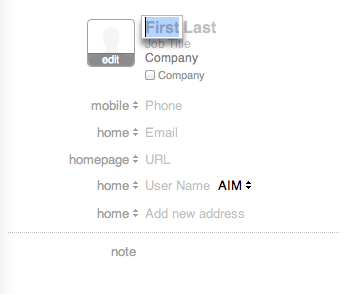
Or fill in all the contact info every field the Address book asks for?

I believe most people’s Address Books, for instance, have half completed data and information in it. Very few people really want to take the time to make sure it is all entered and it is all accurate.

But structured data requires multiple boxes, right? After all, I need to tell the service what goes where so it knows how to catalog the information, make it sortable and searchable, transform it into reports so I know how I am doing. Here is a screen shot from Highrise:

How could a product like this get away with fewer boxes? I won’t say it is easy. I will say it is necessary to make a product more usable, though, and to get more people to adopt it and stick with it.

As developers we need to work a little harder, think a little longer, about how to reduce the number of boxes. It is possible. Take a calendaring application. Traditionally it has lots of boxes: event, location, date, time, from, to, etc:

All of this seems necessary but it isn’t. Think hard about the 90% rule: what will people need 90% of the time and satisfy that need while also making it easy for the anal retentive among us to get access to the rest. Even something as reliant on structured data as a calendar app can accomplish this:

It is amazing how many boxes we can eliminate when we put our minds (and programming muscle) into it.

Isn’t This Part of What OWS and Tea Party Are Fighting?

Tim O’Reilly: Why I’m fighting SOPA

Tim O’Reilly in an interview with Gigaom’s Colleen Taylor:

I talked with Nancy Pelosi about SOPA the other day, and she said that the experience with piracy is different for people in the movie industry. Maybe — I’m not a movie producer. But I do know that right now the entire content industry is facing massive systemic changes, and to claim that declining sales are because of piracy is so over the top. Any company that is providing great content online in a way that’s easy to use with a fair price has a booming business right now. The people who don’t are trying to fight that future.

So here we have this legislation, with all of these possible harms, to solve a problem that only exists in the minds of people who are afraid of the future. Why should the government be intervening on behalf of the people who aren’t getting with the program?

Isn’t this what we are all fed up with? Government doing the bidding of special interests, special interests that use government like it’s a personal shield against every affront that might affect its business. Isn’t this, at its core, what both Occupy Wall Street and the Tea Party are upset about? Using money to influence markets and pervert government.

[article via bryce.vc]