Little Money For App Developers

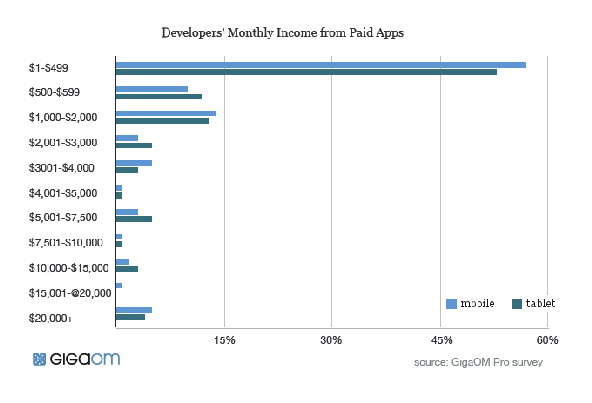
Some sad data from Giga Om on what app developers are making.

More than 50% earn less than $500 per month and about 80% earn less than $2000 per month. Apparently advertising-based apps do even worse, where 1/3 make less than $100 per month. The split isn’t totally unexpected but $20,000 per month in revenues isn’t really that much. That probably pays 2 or 3 people market wages in this industry.

I couldn’t find a number readily but I’d estimate there have been somewhere north of 400 million smartphones and tablets sold in the past five years. Through 1986 there were about 40 million personal computers sold. By December 31, 1986, Apple Computers, Microsoft, Adobe and Oracle, all of whom built themselves specifically in the PC era, were all public. It doesn’t strike me that there are any mobile-specific companies, with 10 times the devices sold, in the same position today.


Apologizing In Advance For Even Writing A Post About Apple’s Maps App

I’m sorry, really I am. Just what the world needs is another blog post on this stupid maps thing. But here I am writing my thoughts on the topic. There are a couple of things I didn’t hear others say and wanted to make the point. So here’s my total collected thoughts on Apple’s maps issues, mostly done through my sick, drug-addled brain this morning:

Is there problems with Apple’s new maps app? Obviously. There are enough funky routes and flyover screenshots to know that.

Why did Apple release a half-completed product? Because the product will remain half-completed until it is released to the world. From what I understand, Maps requires lots of user data to be perfected. Google started this process seven years ago and that’s why its map data is superior today.

Is the maps app really that much worse? I’ve used it sparingly so have no opinion on the maps themselves. I haven’t seen any issues with my limited use. I did hear that China is far better mapped with Apple’s maps app then Google’s. I can also say that the new vector-based maps are significantly superior to Google’s tiles.

Was Google really blind-sided? Hell, no. They knew this was coming, if not now then next year. Everyone knew that Apple bought multiple mapping companies over the past few years. Google should have had an app sitting around internally ready to send to Apple the minute they were cut out. Either way, Google knew they were off the device in June. It’s now September. What has the maps group done in the past three months?

Is Google smart to leave Apple tilting in the wind of bad publicity? If Google is indeed failing to release an iOS version of Google Maps because they want the bad publicity to mount for Apple, then that might be one of the dumbest decisions a company could make. I have repeatedly heard that getting data from customers is critical for a successful maps app. The longer Google delays, the longer Apple gets customer data to refine its maps. If I was Google, I would have had a maps app available on day 1. It would have been the most popular app in the App Store and would cut off Apple’s supply of data.

Is this whole thing a manifestation of the press? Maybe. The amount of writing on the issue is more interesting to me than the issue itself. It is also interesting to me that the press has attempted to get traction with multiple stories before this one. We have already had the camera problem stories (purple haze), aluminum backing scratch problem stories, the connector changed stories, and the App Store changed stories. None of these caught on so the press backed off each one until they found an issue that sticks: maps.

Will this be bad for Apple long-term? No. The press will get bored of the story, Apple will fix the issues, and in the end have a stronger product offering. This isn’t the first time Apple has had controversy around a new release (remember Flash?) and the press is always looking for something to hit Apple with. The flow of bad news will start to peter out over the next week or two and then Apple will announce they sold a ridiculous number of devices and the stock will go up and everyone can get back to speculating on what Apple will announce next.

The iPhone 5

I haven’t been this apprehensive about a new iPhone release since I bought the iPhone 3G back in 2008. I’ve seen and played with enough larger screened devices to know I didn’t like them. They felt too big in my hand and too big in my pocket and I didn’t like that feeling. If anything I often think I want a smaller phone, not a bigger one.

So I debated whether to buy an iPhone 5 or not. I couldn’t go without one for good, that’s for certain. As a developer I have to play with my software on the device in order to see how it works and feels. But I was thinking maybe I’d just get an iPod touch with the 4″ screen and skip this release cycle for the iPhone, wait for the next rev.

It just so happened that at midnight my wife came to bed and I woke up. I still didn’t know what I wanted to do and that was compounded by the fact that when I went online I first saw that I didn’t get the full discount and then the system went belly up before I could make up my mind. A message appeared from Apple, though, saying there were problems, my spot was reserved, and I’d be getting an email in the morning to finish my order. Averting a decision, I went back to bed.

In the morning three things happened: I read John Gruber’s excellent review, found out that no one else on my team was able to order one for the 21st, and realized that the iPod touch won’t ship until sometime in October. So I ordered mine, still not knowing whether I’d use it or go over to AT&T to have them switch me back to the 4s.

Here’s my summary: worth every penny.

I’m so glad I bought it. It is a much nicer device then the 4/4s series. The thing that jumped out at me immediately was the weight. If I held an iPhone 4s in my hand and held an iPhone 5 in my hand, they didn’t feel drastically different. But the longer I held the 5 the lighter it felt. I thought the taller screen would be awkward, too, but it turns out that it feels right. Now when I look at any of its predecessors, they all look oddly small. Some reviewers have commented that the iPhone 5 feels solid but feels like it’s one of those fake devices where there are no guts in the thing. That’s a good summary although not quite that light. When I put it in my pocket I don’t notice it is there. The weight and size feel perfect.

A few things of interest. First, Apple moved the headphone jack to the bottom of the device. This makes sense as it matches the natural way I put the device in my pocket, top down. I no longer risk dropping the phone while I pivot it in my hand before sliding it into my pocket. Given that, it is taking me some time to remember that the power button is on the opposite side of the device and the swipe is closest to the headphone jack.

Second, I love the extra row of buttons on the home screen. I don’t like folders. It hides functionality, making an extra tap to get to anything. With the taller screen, all of the apps I care the most about can sit on my home screen and I still have a couple of slots open for whatever apps I am playing with at the moment.

Third, I am amazed that almost every app I have is already updated for the taller screen. I guess I shouldn’t be too surprised as I mostly use content apps and those tend to be the easiest to update.

Fourth, the transition was ridiculously smooth. Start the device, log into iCloud, and walk away. Everything downloads and recovers, just the way I left it on the previous device. (The update from iOS 5 to iOS 6 on the iPad was just as easy.) I did have to log into a couple of apps that required a password but that wasn’t a big deal.

Fifth, I spend a lot of time in email. Because I tend to want to know who I am when I’m responding (personal, business, etc.), I tend to navigate to different inboxes rather than use the unified one. Apple added two new features: VIP which lets me designate certain people when I hear from them and Flagged, which shows me all the emails that I marked that way. I find these to be a bit annoying with two many inbox badges on the screen, but that’s mostly because it breaks my traditional usage of the email app. I can’t help but wonder if my usage will change because of it.

Sixth, early iOS 6 beta reports were that Apple removed the Podcasts tab from the Music app. I’m happy to report that it was there in the release build. This makes me very happy as I still have one place to go for all my music/spoken word entertainment needs plus can keep a single app on the home screen for such purposes.

Seventh, maps is maps. The app is nice, lots of people have talked about the problems, and I don’t use it enough to care. If you want to learn more about this one, go do a web search as there is plenty of bitching and moaning about it. I will say, though, that Google would be smart to get a version out as soon as possible. Many commentators have been speculating that Google should delay to punish Apple and give Android a competitive advantage. But data from users is the life blood of improving these maps apps. The best thing Google could do is deprive Apple of the customer data they need to improve the product.

Eighth, and last, the camera changes are very well done. I particularly like the new panorama mode. It stitches together an amazingly awesome shot. When I first learned to do this, it was take multiple pictures, scan the slides, then use Photoshop to stitch them together using a burn tool or something else. Now, Apple does it for you and does a much better job then I ever learned to do.

That’s enough for now. I will say that I am impressed enough with it that my wife may upgrade her iPhone 4 later this year when her contract is up. That’s a far cry from where I was at midnight a week ago, trying to decide whether I wanted to invest in the thing at all!
Expanding the Mobile OS Scrum: Here Comes Firefox OS

Mozilla is working on a mobile operating system they call Firefox OS. Its CTO, Brendan Eich, had this to say to TechWeek Europe:

We see an opportunity to serve users by converting them from feature phones to inexpensive smartphones. The action is in the emerging market, not going up against the top end of the market in the US, where Android is chasing Apple.

Smart strategy. If Mozilla is successful with a new mobile operating system it sure is not going to be by going up against Apple, who controls the high end of the market. And it sure wouldn’t be the last time a low-end disruptor was disrupted on the low-end. A low-end disruptor forced to the middle might as well be no where because there is no mid-market.

Android licensees now have to worry about paying Apple and Microsoft royalties, have to compete against a Google-owned Motorola, and apparently have to worry about being kicked out of the open alliance for using an Android OS knock-off for other devices. So maybe Mozilla, unlike Palm’s webOS and Microsoft’s Windows Phone and Nokia’s Symbian and RIM’s BlackBerry OS, is in the right place at the right time?

Maybe. Although Firefox OS could get sued by Apple and its licensees have to pay royalties to Microsoft, so who really knows what the net impact will be. All I know for certain is that every time we shrink an OS maker in this market, we seem to also add one back to the scrum.

[via Parislemon]

What Comes First, Users or Business Model?

Bloomberg Businessweek had an interesting article on ESPN in the September 3 edition. In it the WatchESPN app and ESPN’s mobile strategy was discussed. WatchESPN allows cable subscribers to watch ESPN programs at their leisure, including sporting events. For ESPN, though, many of the programs aren’t showing ads yet since those rights weren’t sold with the television rights. As the article says:

In other words, ESPN has invested in creating content for a platform before business exists to support it. John Kosner, executive vice president for digital and print media, says, ‘We weren’t afraid of cannibalizing our [television] business if the fan liked it … even though the ad-serving technology just isn’t ready yet. We’re not afraid to be ahead of the market. You win by delivering what fans want, and then that becomes a fantastic advertising proposition and a great business.’

Apparently the fans don’t like WatchESPN. When I looked this weekend the app had a two-star rating. Many of the reviews were primarily business model stuff, like let me buy a subscription. I get the sense that ESPN could be the first to move in this direction, if their always cannibalizing street cred is real.

While there is tons of talk of HBO and Game of Thrones program in the tech press, it is ESPN and live sports that is the last thing keeping people tethered to cable. Luckily for me, the sport I prefer (baseball) and the team I follow (Cleveland Indians) are available on MLB.tv. Playoffs are a problem, of course, but the Indians haven’t been good enough lately to have to worry about that.

Another thing that I found interesting about this quote is that ESPN specifically chose to release an app before securing a business model. This seems like a catch-22 proposition. For something that hasn’t been available before, finding out whether people will use it and what they are doing with it is important. Without knowing that information, it is hard to figure out what and how to charge. Without charging, though, we don’t know if there is a business at all and thus makes all those users a moot point. Seems like a classic chicken and egg problem.