Search Changes, Falling Sales and a powerOne First (With Data!)

Last week Apple changed their search algorithms in the App Store. Within a few days, apparently realizing the changes weren’t such a good idea, Apple changed them back. We got caught in the middle on this one and it greatly affected our sales. We were down 30% at one point last week and never really recovered even after Apple changed it back.

What happened? In a nutshell Apple stopped using the title as keywords where they had in the past. Since we use words like “calculator” in our title we didn’t bother including it in the keywords, where we only have 100 characters to work with. So a search for “mortgage” showed us high but a search for “mortgage calculator” didn’t show us at all.

The fundamental issue is that search position and product sales are tied together. If you get caught in a downward trend on one than you also get hit on the other since product sales are a factor in search position.

In order to combat the problem there is only one solution: stimulate a bunch of sales over a sustained period of time to try and get the rankings back up. So we dropped the price of our Pro products to US$2.99. This is the first time in the three+ years of selling powerOne calculators on iOS that we have dropped the price. In all fairness we were considering a price drop anyway. It seems that $2.99 is becoming a premium price point. If all we do is maintain the same revenues with more customers it is a net gain for us. More customers means more people talking about powerOne which hopefully means more customers.

It’s very early but I thought I would show the impact of the top paid position for our two top selling products, powerOne Finance Pro and powerOne Scientific Pro. This is the US App Store for the Finance category for powerOne Finance Pro (the top graph) and the US iPad store for the Utilities category for powerOne Scientific Pro (bottom graph):
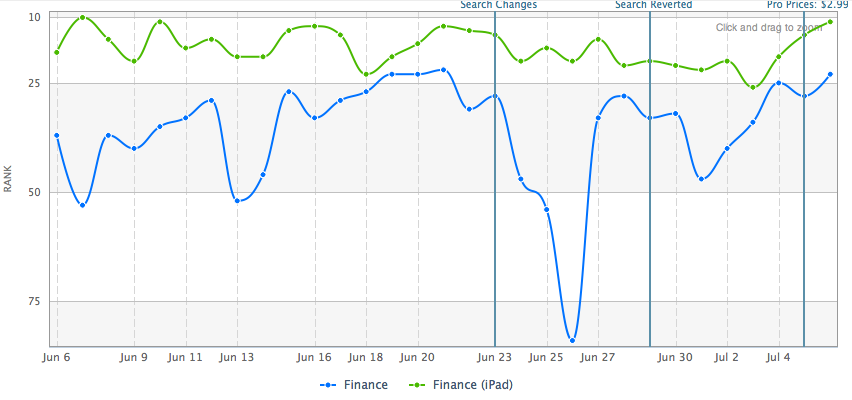
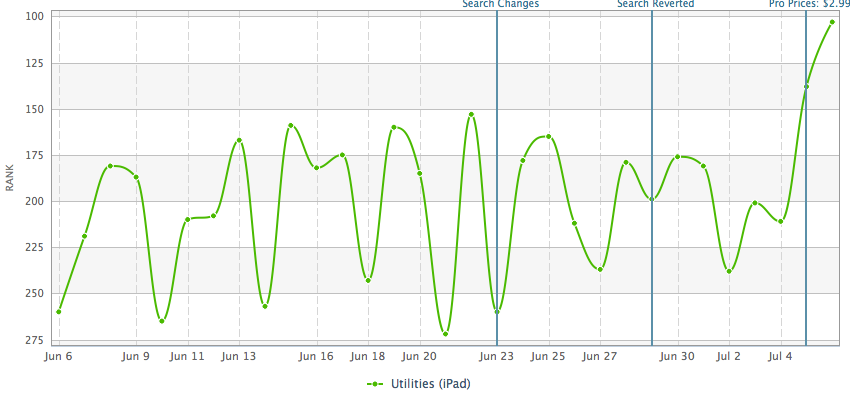
Both graphs show the same time frame with search term changes and price changes marked. We don’t sell enough powerOne Scientific Pro to rank on iPhone app store so didn’t include it. powerOne Finance Pro is by far our best selling product and is the one that has been featured by Apple numerous times. The impact of the search changes is especially pronounced on the iPhone version of powerOne with barely a blip on iPad. This implies that search is more important to us on iPhone then on the iPad App Store.

It is early but the dive toward #1 is very pronounced on both App Stores with the price change. On last check, powerOne Finance Pro was #25 and #4 in its category on iPhone and iPad respectively, and powerOne Scientific Pro was #82 on iPad in the Utilities category. (We still don’t rank high enough to be seen in its category on iPhone.) We haven’t been ranked this high in the Finance category since 2010. This means iPhone has likely leveled out (or peaked) in the Top 25, a very good place to be since the iPhone on App Store shows the top 25 on the first page. Meanwhile, on iPad, our rankings are still moving up the charts.

Again, it is too early to draw any conclusions. We may find that after an initial burst of discount seekers our sales fall back off. We should know more in the next couple of weeks.

[1] Two straight tough weeks for Apple. Apple uses a digital rights management technology to wrap apps before they go in the store. Something happened this week that made downloads impossible to run. Luckily we dodged the second bullet. We had new releases ready to go, too, but when Apple fixed the search problem we cancelled the releases. The downloads affected ran from July 3 to July 5.

Old Farts Know How to Code

Nick Bradbury on getting older in a business where youth is celebrated:

I turned 45 this month. In many professions that’s the prime age to be – and in others it’s considered young –  but in my line of work, some people think middle-aged coders are old farts. That’s especially true when it comes to startups.

I turn 39 later this year and Rick turns 51. Personally, I feel like I have written better code in the past year than I ever have before. I’m not certain age is as much a factor in Portland as it is in the Bay area, but he is right that as I age I have less patience for 18 hour days and 100 hour weeks, back to back to back.

There is another advantage to age, I have found, when it comes to building a business: appreciation. In our heyday in the early to mid-2000s, Infinity Softworks couldn’t afford market salaries but I tried to make the work environment as comforting as possible with a leader who understood the creative process behind coding. I tried to create an environment where everyone can be comfortable and hopefully, in time, get paid more. The older employees seemed to really appreciate that aspect; the younger ones struggled with the lower pay and had no perspective on how bad a mediocre work environment could be.

Of course, I wish we would have had both high pay and a great environment but that didn’t work out for that time period.

100% Effort, 10% Return

One day Michael Mace said to me, “If it takes 100% effort to get 10% returns, it might be time to think of a different plan.”

He said this to me three years ago. It has been running through my brain ever since, but never as much as it has this last week.

Apple’s search term changes — and then reversion back — has cost me dearly. Luckily we aren’t as reliant on income from the App Store as we were a year ago, but all the same. Losing 25% of my App Store sales is really hurting. For the first time in ages I had some financial cover. That cover has pretty much evaporated now. And with it, my ability to focus on the next thing. Now I need to accelerate alternative revenue sources… away from the App Store.


A Lifetime Of Learning Something New

I started programming in 1986 at age 13. I got an Apple IIc for my bar mitvah and it turned into a (mostly) life long passion.

I learned to program in BASIC, which served me well for quite a few years. I self-taught for a couple of years until it was the first language in the first computer science class I had in tenth grade at age 15. I used it off and on for years as the scripting language for Excel as well.

After BASIC I learned Pascal. I used that language in 11th and 12th grade. I didn’t program my first couple of years of college but then took a Pascal then C class in my third year of college. (I went five thanks to transferring from a quarter school to a semester one.) I became proficient in ANSII C, writing various apps on Unix, Mac and Windows, but ANSII C isn’t event-driven programming. Visual C was, though, and I took a semester of it plus a semester of Assembly my fifth, senior year of college. I wouldn’t say I really understood it but I learned enough to get an A in the class and complete my senior project.

That was also the year I started Infinity Softworks, developing our first apps for PalmPilot. That was the year event-driven programming kicked my rear end. The PalmPilot was so crude in those days as a development environment. I also went to graduate school and took a programming class that did a whole bunch of languages in one semester, including Java. That was 1998.

By 2001, though, Infinity Softworks was growing and I needed to focus on the business. I wrote a little bit of Palm code after that, did quite a bit of HTML and CSS (not a programming language — don’t let anyone convince you otherwise) but didn’t write any commercial code again until 2007 when we had shrunk back to two and we had an opportunity to work on BlackBerry (Java language) and Ruby on Rails, the former of which is dead to me and the latter has served me well for the past five years.

In 2008 we started working on iPhone and later iPad, or rather iOS code using the Objective-C language. Since then it has been all Objective-C for iOS, Ruby on Rails, and a little design work with HTML and CSS.

Notice I referred to it as Objective-C for iOS. The problem with developing for a new platform isn’t the language, per say. It is actually the programming calls (APIs or Application Programming Interfaces) into the operating system that are difficult. APIs are usually complex and involved and learning what is provided for you and what isn’t is so crucial to programming on a new operating system.

Well, this week I started learning Objective-C for Mac OS X. And I can tell you I have never had so much fun learning a “new” language. I say “new” because, yes, it is the same Objective-C language but the hard part, all the user interface APIs, are completely different.

I generally find this part of the routine a struggle. But not this time. I am really enjoying learning the OS X way!