Introducing Equals or How We Will All Work With Numbers In The Future

I am proud to introduce you to Equals. Our goal with Equals is to make working with numbers as easy as writing sentences. While we only have a web site up right now, the products and services are coming soon. Please email me with any comments or feedback, and hope you will be interested enough to sign up for notifications at the Equals web site.

We have had many successful years developing powerOne calculators, combining aspects of spreadsheets and calculators into the template format. But the world has changed drastically over the past few years, especially since the iPhone App Store launched in 2008. powerOne was built and designed for that pre-App Store world.

We’ve been looking for something new for a while, something we can build a long-term business around, one that fulfills my thesis that the tools we use to work with numbers need to change just like the PCs we use those tools on have. A few of the reasons we are so excited about Equals:

Customization

Screen Shot 2013-08-13 at 8.57.52 AM

What made spreadsheets incredible is that, while they still required some basic algebra (B3 is nothing more than a variable, after all, no different than X), it allowed customers to craft spreadsheets concretely. Enter a value into B1, another into B2, then add them up with a simple =B1+B2 formula. Immediately the customer can see the results, even change B1 and B2 to see the impact.

powerOne… not so much. In powerOne the scripting language is more akin to programming. The author must think through the entire calculation, remove the equations from the data, and craft the template. Then he or she can plug in numbers to see if it works. This is hard for most people to visualize.

Equals is more like a spreadsheet in this regard. It is much easier to build calculations from the data. But we wanted to take this a step further. Could we start making variables look like sentences so customers didn’t even need to think in algebra at all? In Equals I can name a variable anything, with only a few limitations (for now):

2013 Q4 Sales
Interest Rate
Avogadro’s Number
Acceleration

It worked so well that after a few sessions with Equals it became clear that I could read notes just like I was reading a page with text. I could understand the variables, understand the equations, whether I wrote them or not. This opened up calculations so not only can anyone write one, but anyone can take someone else’s note and customize it to their own needs. This is critical. Life is custom, after all.

Finally, we realized that the way people looked at the numbers physically is different. powerOne and Excel both expect to see calculations in a very specific format. Sometimes that format made sense and sometimes we copied and pasted numbers into Word and other text editors to layout the numbers.

This is no good. These arbitrary barriers between form and function were designed for an era when computers could only handle one or the other. That’s not a problem any more.
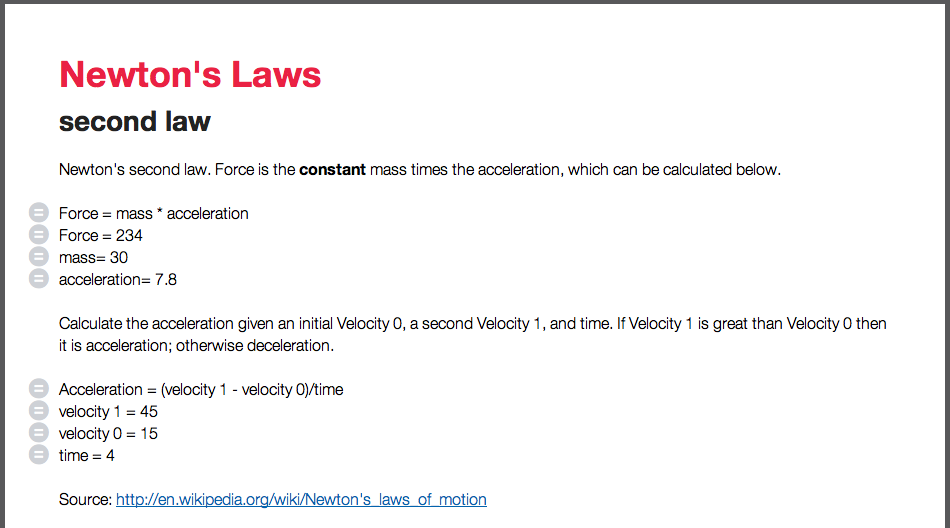
Newton's Laws

Internationalization

powerOne is filled full of text. There are thousands of words of help, template descriptions, labels and more. The cost to bring powerOne to a language other than English was astronomical, let alone our lack of understanding of certain calculations in other countries. Back in the Palm OS days we weren’t hurt horribly by this fact. Now, though, non-US sales of apps, by some reports, account for most app revenue.

One of our goals with Equals was to get Infinity Softworks out of the middle of this localization. The apps and site we are working on is more iconic, less text-centric. The product is your notes, your calculations. Let them be designed and presented in the language of your choice. There will still be some work on our part to localize Equals. That’s fine. Just so long as it isn’t overwhelming.

Cross Platform

As if localization wasn’t bad enough, powerOne is a bear to port. At a minimum we are looking at six months of intensive work for multiple people and that doesn’t include on-going maintenance and support. iOS couldn’t pay the bills around here. Android has been even worse. The motivation to develop for any other platforms is at an all-time low.

When we started working on Equals one of our goals was to make sure we could move across platforms more easily. We focused on putting as much of the technology in HTML5 and ANSII C so we could run it on multiple platforms more easily. This doesn’t mean everything is in HTML and C, however. It means certain core technologies are. We are testing this immediately with both iOS and web versions. We are excited to add Android and other platforms as well.

App Stores

App Stores are an unbelievable resource. The iOS App Store eliminated 70% of our support burden just by handling the install and reinstall issues we encountered in the past. While the App Store is an amazing resource for distribution, it is a horrible resource for making a living wage. We are excited to introduce a product and service that we think is not just valuable to customers but also sustaining for us as well.

In addition, getting out of the app stores allowed us to think more broadly. What does it mean to share calculations? How could this be done easily? What would be an appropriate business model that allows us to get paid and for customers to have a valuable product, whether or not the app stores will support that model?

Don’t get me wrong. The app stores have their place. We just intend to use them for what they are really good at.

Valuation

Long Life

I like products I can think about and work on for a long time. After 16 years, powerOne has reached the end Yes, there were some things we could do to it, features that customers wanted, but the big ideas were already there.

Equals is exciting to me. It has long legs. The way customers will use it, the enhancements we can make to improve it from collaboration to data to integration with other services, gives me years and years of material to work with.

I hope you are excited. Equals ushers in a whole new era for working with numbers, one designed for the web and mobile world we all live in today. The site is ready for your review today; the service, mobile and web apps very soon. I hope you will check it out and tell me what you think.

Changing The World Has No Time Table

I linked to this last week but wanted to highlight this specific passage from Mark Suster’s post entitled Why You Need To Ring The Freaking Cash Register:

Some businesses take time to find their magic. And I only know one reason companies go out of business – they run out of money. Delaying going out of business gives you way more chances at product / market fit than any other strategy I know of.

I’m a freaking master at not going out of business! I’ve been not going out of business for longer than most companies have been in business. Hell, my kids haven’t been around as long as I’ve been not going out of business.

In 2006 it became apparent that powerOne was going to struggle to make us a living, let alone change the world. The problem was I didn’t have anything better.

I could have changed my thesis — that the tools we use for working with numbers hadn’t changed since the advent of the personal computer even though the personal computer had — but felt that changing the world of numbers was an audacious goal that impacted all segments of life: how we work, how we live and how we learn. I didn’t want to start a new thesis from scratch.

So we bided our time. We tried other products, a web education platform called MathPoint that almost got us acquired then a powerOne-like platform called FastFigures focused on the data. We also experimented with two or three other ideas that didn’t make it off the ground.

We kept moving forward. We worked hard on versions of powerOne for iOS, Android and Tizen. We learned Rails and did contract work to fill the financial gaps. We rebuilt our skill set around modern languages for the day when we had the right idea. We kept our tiny little team, reduced from 13 in 2003 to 2 in 2006, together.

Many people thought I was mad. I saw the steps as ends to a means, a long planned out path that most people couldn’t see. I knew, if I just didn’t go out of business, that all the learning, all the experiences and all the observations would coalesce into an unmistakably earth-shaking product.

More on that tomorrow.

Good Reads III

Periodically I get backed up. There are a number of really good posts but I just don’t have a lot to say about any of them. Since I don’t really want this blog to be a link blog, I try to only link individually to those I have something to add. Given that, though, there are a number of posts lately worthy of your attention. So I include them here, all at once, for your enjoyment:

  • Do Things That Don’t Scale by Paul Graham. Paul writes some amazing essays and this is no exception. I’m a sucker for contrarian thinking, though. Paul talks in depth about doing the little things no matter how time consuming, especially in the early days of a new business or product. Don’t worry, he says, if they don’t scale. Once product/market fit is achieved you can figure that out.
  • Why You Need To Ring The Freaking Cash Register by Mark Suster. Great post on why you don’t know your business until you take the customer’s money.
  • The Sweet Smell Of Success by Seth Godin. I like this section best: “You will be labeled, like it or not. If you earn the label of, ‘person who builds things, ships them and sells them to someone who values them…’ you’re way ahead of the pack. You’re going to be doing this for a long time.” I sometimes wonder how I’ll be remembered. I hope it’s for shipping great products that are used by lots of customers.
  • The Idea Maze by Chris Dixon.  The latest conventional wisdom is that the idea doesn’t matter. I never understood this. The idea, I think, is critical. Without it there is no business. Chris Dixon takes the conventional wisdom to task.
  • Why Mobile Web Apps Are Slow by Drew Crawford. Fascinating in depth and technical discussion about the state of Javascript in web browsers, especially mobile ones. I partly agree with him. Javascript is slower in mobile web browsers (and I’m in no position to discuss the future.) But he talks about Javascript in browsers in extreme cases like photo and video editing. I’m writing hybrid apps as we speak and Javascript performs admirably on both desktop and mobile web browsers for my usage. As with all things in life, pick wisely as mileage may vary.
  • The Leaping Startup by William Mougayar. My first time linking here to William but he has an incredible investigative mind. Why, he asks, do some companies explode after product/market fit and some struggle? One possibility: listening too closely to your customers.


Jeff Bezos And The Future Of News

Jeff Bezos, in a memo to Washington Post employees after he purchased the company:

The values of The Post do not need changing. The paper’s duty will remain to its readers and not to the private interests of its owners. We will continue to follow the truth wherever it leads, and we’ll work hard not to make mistakes. When we do, we will own up to them quickly and completely.

Once upon a time, when towns were small, all news was passed over the fence, neighbor to neighbor. Did you hear about the Johnson girl? I didn’t but I did hear that there’s a sale down at the general store.

As towns grew bigger the dissemination of news became more centralized and the desire for a single news source increased. The town paper had authority and ethics and all the things we expect from a paper of record.

As the towns grew into cities it was no longer good enough for that paper to just provide the local sports scores and happenings on Main Street on Saturday night. Now it had to provide national news as well. Every city bigger than a couple  hundred thousand people had a paper with both national and local news. Every paper, outside of the evening news, became the source for all information.

And then the Internet came along and suddenly we could get national news from anywhere. This diminished the value proposition of the local paper and that diminishing value meant diminishing financial returns.

You know all this, of course. It’s been discussed ad nauseum for years now.

I believe, however, that at some point we will reach a tipping point where local papers become local papers again and a few national papers become the paper-of-record for US news. At this point it is clear that three papers have the ability to make it as national news sites (paper will go away) of record: The New York Times, The Wall Street Journal and The Washington Post. Others may survive also — The LA Times, The Atlanta Constitution, the Miami Herald — but these are the three worth betting on.

A massive overhaul will be required, a re-organization of the mission and goals of these venerable institutions. But if I was a betting man — one with an interest in journalism and money to burn like Jeff Bezos — a bet on one of the Big Three sure makes for an interesting play.


The Big “Mo”

The last seven days have been some of the most productive of my professional career. We had been having a problem with the underlying code for our new product for a long time. The bugs we found were very hard to track down and even harder to fix. Every time we fixed one it seemed to create three more.

A week ago it finally reached a head and we were forced to re-write the entire way it is handled. My designer came up with a new approach and I sat down to implement it.

Over the course of seven days I caught what can only big described as the Big Mo: momentum. Everything fell into place, every trick I tried worked exactly as I had hoped it would, every search term I typed into Google returned the answers I was looking for.

If you don’t code you may not understand what I’m getting at. It’s the equivalent of a baseball 6 for 6 with four home runs day. It’s the equivalent of taking your dead car to the mechanic and finding out it was a $0.50 screw that he replaced for free [1].

As my coding partner in crime said, when you’ve got momentum, keep going. So I did.

I wrote code for seven straight days. When I wasn’t writing code I was thinking about writing code. When I slept I dreamed about code.

Last Wednesday, after seven days, I completed the last piece of the primary puzzle and shut down my code editor for the night. I was exhausted. But it didn’t hit me until Thursday morning. I was far more than exhausted. I was burned out.

So I shut things down for a few days to refresh. I had meetings all day Thursday and worked on other things Friday and didn’t turn on the computer all weekend.

Once upon a time I could write code 60-80 hours per week for months on end. But now I turn 40 a month from today and I just can’t put in intensive weeks like that any more. I still work constantly, but writing code is a different story.

I’ve always been a big momentum guy. I don’t want to stop once I get on a roll. In my forties, though, I hope to do a better job of controlling that instinct.

[1] Actually happened to me once.