The End Of Blockbuster, The Foreshadowing Of Something More Ominous

I’m surprised it took this long, but DISH Networks is closing down the rest of the Blockbuster stores.

Apparently the average store was 5000 square feet, which means at its peak Blockbuster accounted for 45 million square feet of retail space! According to this article there is 14.2 billion square feet of retail space or 46.6 square feet per capita. According to the same article there were 1.1 million retail establishments in the US, or 1 establishment per every 313 people. Walmart generated revenues of $444 billion in 2012, $310 billion of that in the US. In fact the top 10 retail establishments alone generated $2.2 trillion of revenue in the US alone!

According to this article, we spent $200 billion online in 2011 and that is expected to rise to $327 billion in the next couple of years, although my guess is that is low. In 2012, Amazon alone generated $61 billion in revenue, all online of course.

I have shopping down the street. In fact if you live in the US almost everyone has shopping down the street. The former Borders store is still completely empty and across the street the remnants of the Blockbuster sign are still visible even though it closed years ago. Across town the Party Warehouse store sits empty and over by the mall the former Circuit City store has never really found a permanent new resident.

Meanwhile many more are on the brink. Can Best Buy survive and its 56 million square feet of retail space? How about Sears and J.C. Penney?

Why do I bring all this up?

Think of all the retail space Blockbuster controlled at its peak. 9000 stores. 45 million square feet. Think of all the employees that worked there. All those stores, all those employees without jobs, gone. Done in by Netflix, primarily, who employs next to no one.

If Walmart gets destroyed by Amazon then where do people work? Does Amazon hire them all as local delivery people?

So here’s the theme running through my head: as more businesses go online, as Amazon does to Walmart and Best Buy what Walmart and Best Buy did to mom and pop shops everywhere, what moves into these retail outlets? And where does everyone work? And if people aren’t being paid, then how do they buy goods and services, which keep other retail stores alive? And if people aren’t making money then who pays taxes that pays for the military, social security, Medicare, schools and all the other things a lot of people have come to expect from our society?

I’m not saying it’s going to play out this way. Something has always come along and smart people have shifted, from farms to factories to retailers.

But it doesn’t mean we can keep assuming the same rules apply, either.

Proper Badge Etiquette

I’ve spent a lot of time traveling the past month and was at a great number of events. At every event I went to they have some personal identification to  attach to the body, whether that is a badge with a clip, a badge on a lanyard to hang around one’s neck or a sticker.

The badge is important. These events are often quite loud and it is hard to hear a name. Plus I found I met so many people that names ran together, so having a badge to refer back to is important. The badge itself really only needs to say one thing — the person’s name. And the first name in particular needs to be very large. Bonus information is a company name, which can act as a conversation starter. (“So, what do you do at XYZ Corporation?”) It amazes me how few conferences get this right.

Since I have been at so many of these in the last month and I repeatedly see the badge screwed up, I thought I would provide a primer on proper badge etiquette.

Hang it high as close to the face as possible without being weird.

namebadge-correct

This is the best place. By hanging it as close to the face as possible — and assuming the name is big enough — it allows me to quickly glance down to see your name without truly diverting my entire head. By being able to glance down quickly, this keeps me from admitting visually that I forgot your name already. When hung lower I end up spending the entire conversation trying to figure out how to look at your name without looking like I forgot your name, which in essence causes me to miss the entire conversation.

The name needs to be as big as possible.

namebadge- small

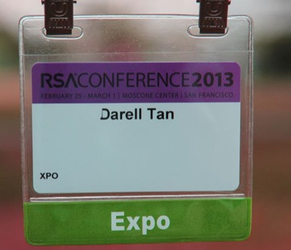
Come on! You’ve got a whole card to work with. Write it big so I can see it. There’s no reason to save the rest of the card for anything. In this case the conference name is bigger than the person’s name. Do they really think I don’t know what conference I’m at?

Don’t play hide the name badge.

This one drives me nuts. The conference goes through all this trouble to provide name badges and then you stick it on a shirt and put on a jacket. The badge is behind the jacket. What’s the point of that?

Lanyards work but it isn’t the best option.

namebadge-secondbest

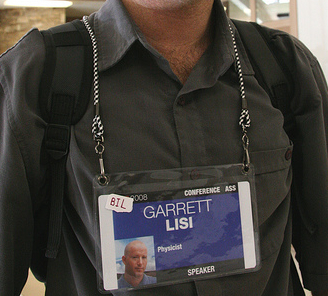
Lanyards — the piece of rope they use to put the badge around your neck — works, too, but they are usually too long. When talking to someone the badge usually ends up around the sternum, which when talking to someone is too far down to glance at and easily see what it says. Remember, at conferences we don’t talk at a normal distance. At conferences, just to hear the person you are talking to, we tend to stand at an inside-my-aura distance. This makes a low-hanging badge extra hard to see since the angle is all wrong.

Backwards name badges suck, too.

The lanyard badge above is a great design. It is very hard for it to flip backwards. But most lanyards have one tie in the middle and thus flips around backward. If you are organizing a conference, don’t be cheap. Buy the better lanyards. If you are at a conference with these flippable badges then it takes constant vigilance to keep it facing name-out.

If you are female don’t hang it on your breast.

namebadge-breast

For goodness sakes, I feel like a total creep the entire conversation if I need to look at that badge. Really. Even if you like it, I don’t.

I really don’t want to be glancing at your chest. Because of the placement I tend to glance fast — I don’t want to stare at some woman’s chest — which means if I miss the name I have to glance again! Oh, how humiliating.

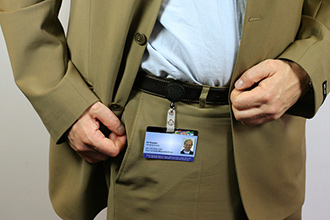
And finally, never, ever hang it on your belt.

namebadge-crotch

Seriously, folks, no one in their right mind wants to stare at your crotch.

Thinking Long-Term

A couple of weeks ago I mentioned that I was at a conference and waiting to meet Steve Blank when he abruptly left and I ended up meeting Tim Gieseler instead. I wrote about this in a post called Accidental Meetings. Tim ran his business, Orion Telescopes, for over 30 years. In January I will start year 17 for Infinity Softworks.

One of the things we talked about was the challenges of running a company long-term. As he pointed out, thinking in terms of a decade or two instead of a year or two changes one’s perspective on the business, particularly when dealing with business fluctuations.

When thinking short-term, there isn’t a year or two to let the business grow naturally, to take its winding and weaving course, to let the business be the living, breathing thing that it is. When thinking short-term the business managers are forcing it in a certain direction, needing it to grow in the manager’s timeframe.

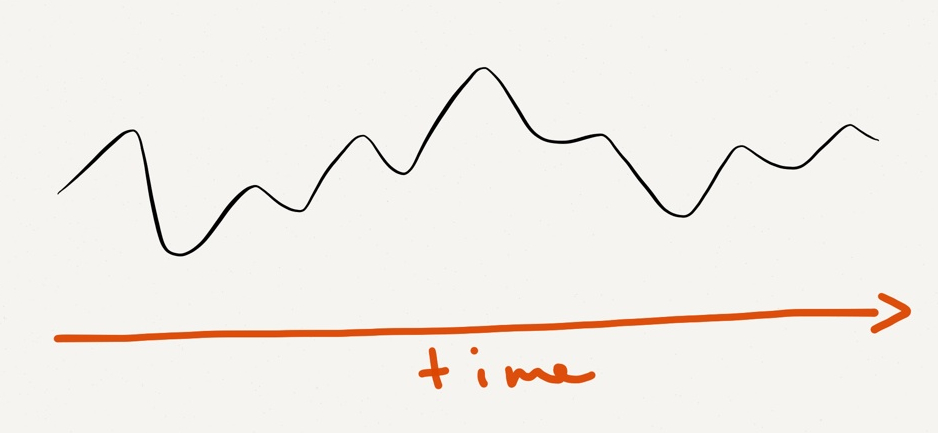
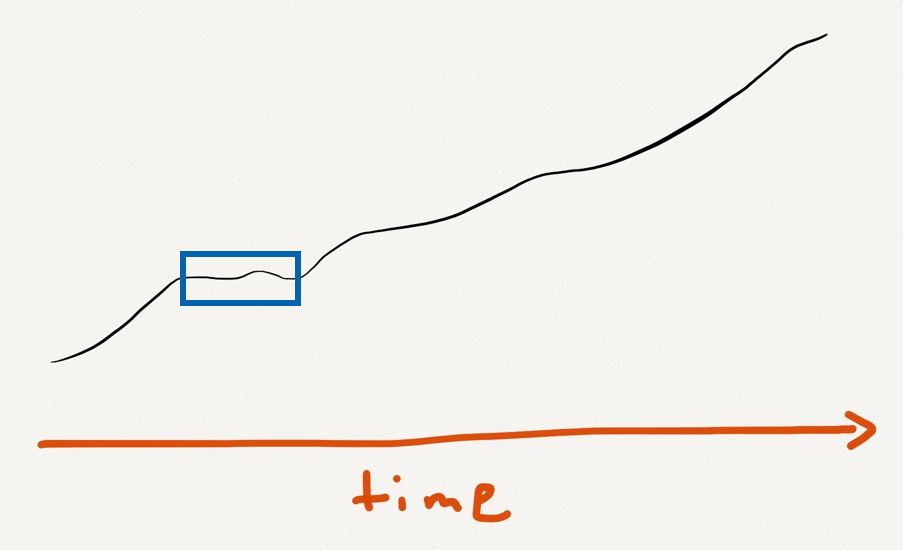
We’ve been experiencing a dip in the business the last few years. In fact for the first time professionally we have been doing contract work to pay the bills. If I was to zoom in on this two-year period, the graph may look a little something like this:

dip zoomed in

Pretty flat overall with a lot of ups-and-downs month-to-month.

If I was working on a short-term business, one I hoped to sell in three, four, five years, then this period would be fatal. It would be a lot of treading water, which I couldn’t afford to do.

But I don’t see business this way. I see it as something that needs to grow and change in its own time. Hopefully, when I zoom out on the life of Infinity Softworks, this period will seem like an inconsequential dip somewhere in the middle:

dip zoomed out

As Tim said, there is a natural cycle to these things. Just keep pushing through it if you believe in what you are doing.

Wealth Inequality in America

There has never been a time in US history where the wealthy have so much and the rest of us have so little. And by wealthy I’m not talking about those making a few hundred grand a year. I’m talking millions a year, the top 0.1%, the top 0.01%.

What’s more disturbing is that we can’t begin to have a conversation about how to deal with this problem — whether it even is a problem — until we all actually understand the distribution itself. And the reality is most of us only think we understand it.

This amazing video uses infographics to help explain the disparity. I hope you will take six minutes and watch it.

Finally Ready For Take-Off

The FAA announced today that we can use electronics during take-off and landing, as long as we turn them on “airplane mode”:

The U.S. Department of Transportation’s Federal Aviation Administration (FAA) Administrator Michael Huerta today announced that the FAA has determined that airlines can safely expand passenger use of Portable Electronic Devices (PEDs) during all phases of flight, and is immediately providing the airlines with implementation guidance.

I’m so excited! When I fly, I end up taking my iPad, Kindle and a magazine. I read the magazine only on take-off and landing so end up trying to ration the magazine to make sure I have enough to last the entire trip. I then use the Kindle and iPad during the flight. I’m a minimalist when I travel, taking the absolute bare essentials, packing as lightly as I can. Eliminating anything, even a magazine, is a big deal, especially since the magazines I read are also on my iPad in electronic form.

There are some addendums and provisos, of course. In particular, airlines get to choose whether they will support this or not and on what airplanes. And there may be times, like during low visibility, when they want devices turned off. TechCrunch has a pretty good list going.