A Crazy Couple Of Weeks

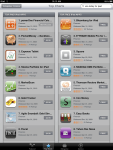
Wow! This has been a great couple of weeks. Two weeks ago we were still discussing an iPad version of powerOne calculator. Since then I have had lots of meetings, a trip to Apple HQ (with Dick Luebke), shipped an iPad version of powerOne (universal as the same version works on iPhone, iPod touch and iPad), a new device arrived (the first time in my personal history I have ever bought a first generation technology — I’ve been dying for a tablet device like the iPad for a decade). Finally we were featured in the iPad App Store and… a #1 ranking in the Finance category!

A few pictures to remember these couple of weeks by (click on a picture to enlarge it):

Apple and the Mainstream Tipping Point

Apple doesn’t always win markets and they don’t always invent them, but when Apple enters a market it is almost always the tipping point to mainstream adoption.

Proof:

  • The Apple II series was the first main stream computer. They eventually lost ground to the more business-friendly IBM PCs, but it introduced computing to the masses in a way no one before was able to. (And for us students, it is what we grew up using with the Apple IIe seeming to be in every school.)
  • Next came the Macintosh. It was the first truly mass consumed computer with a Window-based user interface. Of course, it lost out to Microsoft and Intel once Windows 3.1 and 95 were introduced.
  • We have to wait a while — 16 years actually — for the next major wave of computing. And this market Apple won: portable music players. While the iPod wasn’t the first (just like the Apple II series wasn’t the first) it quickly came to dominate the market and maintain its dominance through this day.
  • Next came the iPhone. Again, not the first smartphone but its introduction completely changed the landscape for cell phones, instantly raising the bar and inspiring competitors. The jury is out on this one. There is a long way to go when it comes to defining a winner as only about 2% of the cell phones sold worldwide are smartphones today.
  • And now we have the iPad. Unfortunately many media pundits are exclaiming stupidly that Apple is inventing the market. That’s far from the truth. Microsoft really pioneered the market 10 years ago with the Tablet PC operating system. For many reasons it was a flop. Apple is re-inventing it and from first take, doing it the right way with the right price.

So while Apple has not always invented the market or even been the eventual winner, the company (Steve Jobs?) has an uncanny knack for understanding exactly when a market is ready to go mainstream and is consistently a major player in the outcome.

Lets hope Apple’s 5 for 5 with the introduction of the iPad. I believe it is.

Disclaimer: I have a vested interest in Apple’s mobile success as powerOne calculator is available right now for iPhone, iPad and iPod touch.

Higher Taxes, Less Services A Thing of the Present

I live in Oregon. In the election in March we passed two new tax increases, one on people making $200,000 or so per year or more and another on all businesses. The business tax raised the minimum and also passed, for the first time in state history, a revenue (sales) tax. I contend that the business revenue tax is debilitating and will likely drive companies out of the state, particularly given that the next state over, Washington, is a 10 minute car ride from Portland.

In today’s Oregonian newspaper is an interesting article about how each state ranks from a tax burden perspective. According to the rankings by The Tax Foundation, Oregon dropped from number 8, ahead of Washington State in 2009, to number 14 for tax climate. Their ranking, available here in pdf format, takes into account corporate, individual, sales, property and unemployment taxes. Not as bad as I thought.

I still believe that the revenue tax will go down as a bad idea. I think the unintended consequences of the business revenue tax will make Oregon’s tax collection worse, not better, as it drives companies and employers away. It also puts Oregon on a different playing field from other states as it is an unusual tax for a state that has no personal sales tax rate. (Washington State has a revenue tax but they don’t have an income tax.) Infinity Softworks pays 4% more in taxes than my neighbors across the border, which isn’t a big deal until you realize we are talking about another employee ($80,000) on $2 million in revenues. And when we are losing money it is even more painful as now I have to pay the government instead of myself.

The reality, though, is that every state — and the nation as a whole — is soon going to have to re-think taxing and spending. Our governments cannot continue to support the current plethora of programs without raising taxes significantly (or vice-a-versa). Without cutting spending or raising taxes we will be dealing with much more significant problems soon enough.

Some Lessons I Need To Learn Twice

You’d think after 13 years I’d know better. Some lessons, though, are easily forgotten.

On Thursday last week we shipped version 1.1.2 of powerOne Financial Calculator to the App Store. It was accepted into the store on Friday. Saturday morning the first bug report rolled in that there was something wrong with template creation. It was pulling other templates in. Testing on this problem led me to a bigger problem — any templates created before version 1.1.2 were hidden from view.

On Saturday evening, after a half hour bug fix and a day’s testing we shipped version 1.1.3 to Apple, which was accepted into the App Store today. Luckily we escaped major catastrophe as neither bug was fatal — all previous templates were recovered and new templates are now created correctly again.

We have been at such a frantic pace here that we got lazy about testing. Sure, we were testing around the areas that were changed but we weren’t spending time testing everything before release. We didn’t think we had touched these areas — user-created templates — with version 1.1.2. We were wrong.

I learned this lesson the first time in March 1999. We shipped version 2.0 of FCPlus Professional… then version 2.0.1 then version 2.0.2 then version 2.0.3 all on day one. Nasty lesson learned.

So a reminder for this decade: write test cases, expand test cases, and actually step through them all before shipping.

A lesson learned that only caused a day’s panic and three days worth of consternation… but nothing else. Luckily.

Why Infinity Softworks Focuses on iPhone

We receive a number of requests each week regarding powerOne software calculators on different platforms or different devices that we don’t support yet. We love these, by the way, so keep them coming as it helps us prioritize when it comes to new work.

We currently have product for iPhone, iPod touch, BlackBerry (non-touchscreen devices), Windows Mobile (touchscreen devices), and Palm OS. The Palm OS version runs on webOS devices if you purchase Classic emulator. And the iPhone version will run on iPad, although we have already started working on a native version.

There are some market dynamics at work, and this is why we have not yet supported Android, webOS natively, BlackBerry Storm or Symbian devices. I’ll outline that here.

First we are a small company, able to focus on one platform at a time. Developing for a new platform is expensive and the return on investment is long due to the fact that powerOne software calculators are fairly complex to develop. There are lots of development reasons to focus on one platform but there are some market dynamics also.

BlackBerry

We wrote a first BlackBerry app before RIM announced their touchscreen devices, which are a completely separate development process on the front end. RIM has plenty of users — adding about 20M per year — and hypothetically these folks are right in our wheel house as they are a “professional” device.

For us, there are two major problems here. First, it is not clear that the BlackBerry devices are really available to third-party apps like ours. A lot of those sales are to consumers who like to text and send email but wouldn’t purchase a financial calculator. Another large chunk of customers work for corporations that lock down those devices, not allowing their employees to install software on them.

The second major problem is one of discovery. Since there is no unified location for people to find BlackBerry apps, it is very unclear how powerOne would be discovered beyond word of mouth. We spent months marketing this product without a lot of success. We also partnered with RIM thinking they’d help but their Alliance Program is geared toward what we’d do for RIM rather than what RIM would do for us.

I’m still convinced BlackBerry is a good place for us, but clearly not the one where we are going to make a lot of money in the short-term, and, as we needed to prioritize, iPhone with its 75M devices and centralized discovery site took precedence.

Android

Android is just getting hot but few developers are making money on that platform yet. What do I mean by making money? I mean making enough money to pay for three people and cover the bills, which runs at least $20,000 per month (for very low salaries).

There was a great story recently about a developer who made $13,000 in a month (not per month, in a month) and this was heralded by the press as a sign that developers can make money now on Android. But it was clearly an outlier case that occurred because Google featured the app. An outlier case for iPhone is millions of dollars per month, a huge difference.

I have other concerns — like platform fragmentation — but these won’t stop us. Could we do well on Android? I think so. But we started on iPhone and need to see that through before we jump to a new platform and take on that multi-month development cycle and learning curve.

Symbian

We have more requests for Symbian versions than any other, simply because of the length of time it has been around. I have two concerns here. First, will it survive? The main hardware platform has been Nokia and Nokia is putting a lot of time and effort into its Maemo and now MeeGo platforms. Will the company keep using Symbian OS?

The second concern is localization. Since powerOne is highly specialized and Symbian is primarily used in Europe, we’d need to understand the computations used in Europe to make sure we create the right ones. Plus, we’d need to localize the app into European languages, which we’ve never done before.

webOS

So many questions here: will Palm survive? Can they sell enough units to pay back the investment required? Is the Classic emulator with powerOne for Palm OS platform good enough?

Until a month ago we couldn’t even think about supporting it as we have a large chunk of code written in C or Java that we needed to use. Palm had no way of supporting that and had denied to my face that they ever would.

I have to admit there is another factor here. In 2004-5 Palm made three moves that hurt Infinity Softworks badly. After all the work we did to support their platform, these three moves — ending our bundling relationship, jacking up the costs to sell software through their site, firing their education team — killed our business plans and sent Infinity Softworks on a downward spiral that almost ended the company in 2007. It’s a lot like being dumped. It’s really hard to stay friends with old lovers.

Windows Phone 7

Uhhh…. vaporware at the moment.

iPhone, iPod, iPad

We made our bed a year and a half ago when we picked iPhone as the platform to rebuild Infinity Softworks. We’ve learned a ton over the past year about developing and marketing a product. Now is the time for us to make it work. And that’s why we stay focused on iPhone.