The Gold Rush Never Started

David Barnard, indie developer of fine iOS productivity apps, took an awesome look at Sparrow this week. He was able to closely compare it to his own development of Launch Center Pro. For those unaware, Sparrow was a highly publicized email client for Mac OS and iPhone. Most people loved its design. Late last week it was announced that Sparrow sold to Google, who promptly discontinued development. Lots of people (customers, developers, pressmore and more) all chimed in on the good, the bad and the ugly of this.

David’s comments mirror my own productivity app experiences:

Sparrow did everything right. They built an incredible email app with broad appeal and released it into the hottest software market the world has ever seen. And yet it was a financial flop.

Keep in mind that this app, and David’s Launch Center Pro, are some of the most successful apps ever launched in the App Store. They are among the Top 0.1% of all productivity apps ever launched, and David’s response is that Sparrow was a financial flop. Read the post because he goes on to demonstrate exactly why it was a flop.

It is important to note that David’s post is geared toward productivity apps in particular, but here is his spot-on conclusion:

The age of selling software to users at a fixed, one-time price is coming to an end. It’s just not sustainable at the absurdly low prices users have come to expect. Sure, independent developers may scrap it out one app at a time, and some may even do quite well and be the exception to the rule, but I don’t think Sparrow would have sold-out if the team — and their investors — believed they could build a substantially profitable company on their own. The gold rush is well and truly over.

I’m not convinced, though, that there ever really was a gold rush in productivity software. Games [1], yes, but not productivity apps. A few of us have been able to scratch out a lower-than-market-wage living for the past few years but I think those days are coming to an end, too, for 99% of developers.

As I look ahead I am uninterested in one-off revenue applications. Without being paid to do so, I doubt I will ever write one again. [2]

[1] And even there the games market is abandoning one-time paid apps for recurring revenue models using in app purchase.

[2] To my existing customers who will inevitably ask: yes, we are getting paid to write for Android. It will be a one-off priced product similar to the iOS version.
Breaking Down Android Devices and OS Version [Survey Results]

As I have mentioned before, we have begun work on an Android version of powerOne calculator. Over the past few years we have accumulated a list of about 375 people who emailed us requesting an Android version of the app. To help get a feel for what is out there we conducted a brief survey. The response was incredible, over 50% response rate.

Two questions, I think, are most pertinent for sharing: 1) What device are you using; and 2) What operating system version does it run? Obviously this is a very small sample of people who were self-selected and are primarily in the United States. This data may not match the Android market at large.

Devices

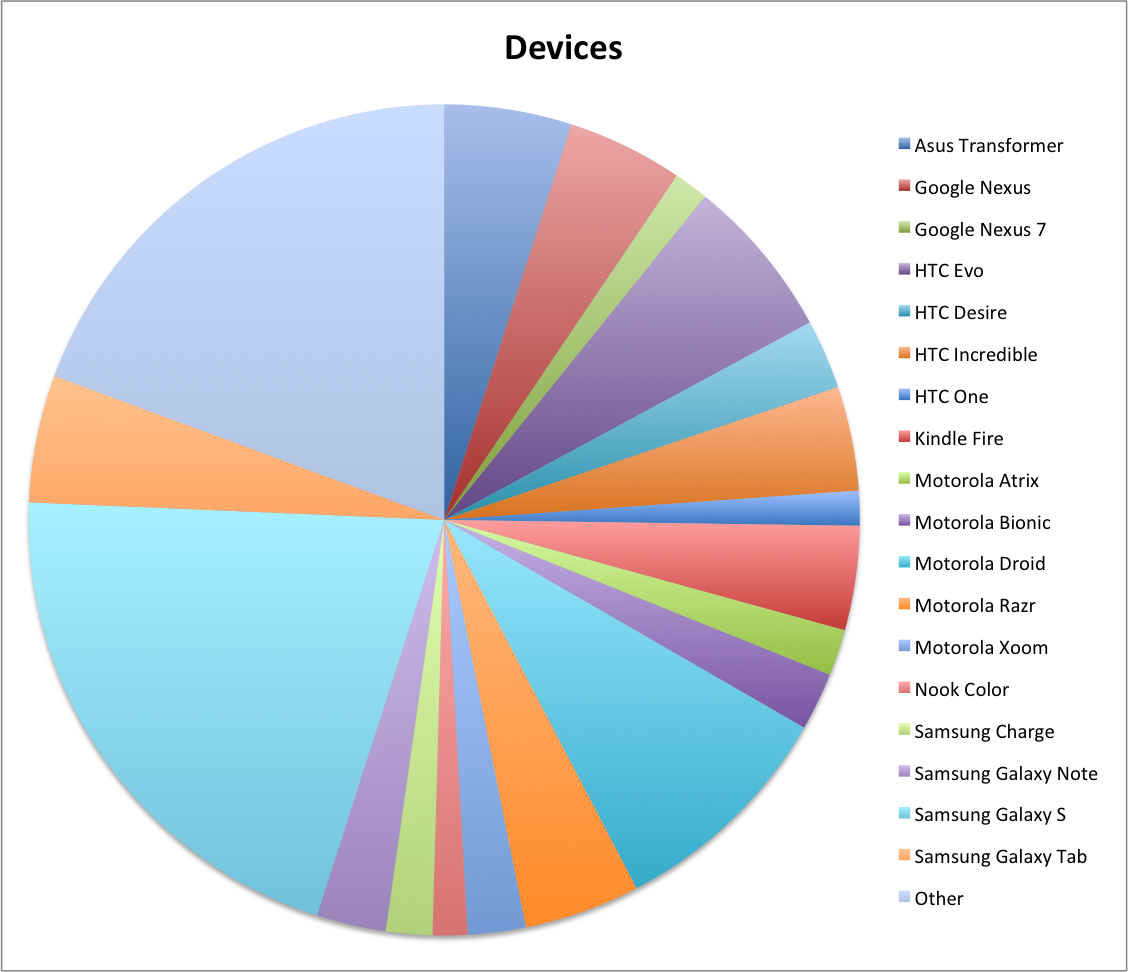
The devices were scattered all over the place. The average per person was 1.2 devices per person, which means that one out of five responders had two devices. The most popular device series in use was the Samsung Galaxy S series, followed by a wide margin by the Motorola Droid devices and HTC Evo series. Of the tablets the Asus Transformer was the most owned followed by the Kindle Fire. Not surprising at all. There were a few votes for the Nexus 7 and a few more that said they would buy one in the future. Here’s the breakdown:

Other is just slightly a smaller pool than Samsung Galaxy S, an amazing array of devices.

Operating Systems

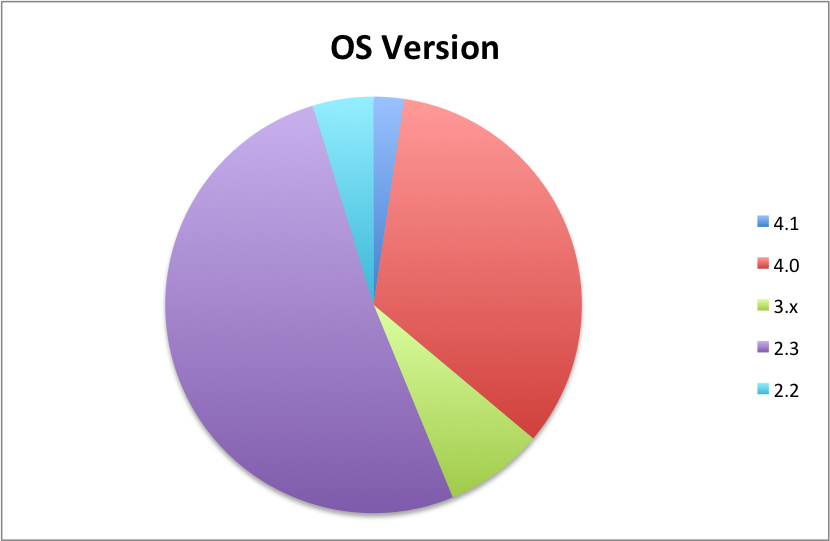
Luckily the operating systems were much more straight forward. There were two primary OS versions: 2.3 and 4.0. Apparently a few vendors are releasing 4.0 or 4.1 operating system updates as a number of customers mentioned that they were updating their OS version soon. Personally, I was pleasantly surprised by the uptake of Android OS 4.0. Based on all the public data I’d seen it looked like 2.3 was very dominant and 4.0 had little uptake. At least this group is reporting differently.

powerOne is the kind of app that cares less about the device and more about the screen size and OS version. powerOne doesn’t have streaming needs or heavy networking needs so we generally don’t have to worry about minute changes between devices. This is why I care more about the OS version data here than the device data above.

What We Have

Since I shared what this self-selected group has, I would be happy to share what we have here, too. We have three devices: a Samsung Galaxy Tab 10.1, a Samsung Galaxy SII and a Nexus 7. The development is being performed by a partner and they have a plethora (I love that word!) of additional devices. The OS version is 4.0, 2.3 and 4.1, respectively.

Other Questions

As mentioned above device and OS were the two primary questions. We asked two others. The first is does your device have a hardware keyboard? About 10% of devices did. The second was more pertinent to powerOne: do you use RPN input mode? There were three possible responses: not important, prefer it but can live without it, and it’s a requirement for me to buy. 23% said it was a requirement. 48% said it was a requirement or preferred. I have no doubt that this is very high for the calculator population as a whole but the HP12c had a huge influence on the financial calculator market specifically. I’m sure many in this self-selected group were heavy 12c users before our software and the PalmPilot came out.

The Future of Touch, Before The iPhone

Yesterday I had commented that the iPhone wasn’t the first pocket computer but it was the one that figured out the combination of browsing, media and general computing the best. There was this other thing that the iPhone did that others failed to do well before it: multi-touch. MG Seigler linked to this Ted Talk from 2006, one year before the iPhone shipped, of Jeff Han demonstrating multitouch. This came up because Jeff’s company was recently bought my Microsoft.

An amazing demonstration, even six years later it is very cool.


The Original iPhone Wasn’t The First Pocket Computer But It Was The Best

There has been a lot of talk lately about how Apple’s introduction of the iPhone was an amazing change because they treated cell phones for the first time as computers. But this isn’t true. It wasn’t the first time.

When PalmPilot’s shipped, Palm positioned it as a connected organizer. Microsoft released Windows Mobile and positioned it as a computer you would carry around in your pocket. Palm responded by becoming more and more computer-like. For some reason, Palm dropped hand writing recognition for hard keyboards, as did everyone else in the industry.

Apple wasn’t the first by a long shot.

When Apple came along, though, the industry was moving into silo-ed products. My desktop computer accessed the entire web, my cell phone was used for calls and the occasional app, and my iPod was used for entertainment. I, personally, was very frustrated that I had to carry multiple devices around. Sure, there were mp3 players for Treo’s and BlackBerry’s, but the experience was horrible, much like Rio MP3 players before the iPod came along.

Apple had the perfect timing. They combined their amazing infrastructure for entertainment and music playing with the full Internet in your pocket on a stunning device that did just enough to make phone calls. That’s not “bringing the computer” to your pocket. That was an old idea. What it did do is bring the right combination of capabilities on a single device.

[1] In a twist of fate, I wrote this last week but didn’t post it. Horace Dediu of Asymco basically said the same thing in an interview with John Cox at Network World that I just saw this morning.