Why The New iPod Nano Is Interesting

Of all the things that Apple announced last week the one I can’t get out of my head is the iPod nano. It is by far the least consequential of all the products updated. iPod sales are falling off quickly as more people carry phones that can play music. The iPod classic and iPod shuffle haven’t been changed in years and it seems like the iPod touch only gets updated to keep it in line with the iPhone. And yet, as John Gruber and Om Malik pointed out on last week’s The Talk Show, the nano shared the stage with Apple’s most consequential product, the iPhone.

But is it really inconsequential? Or is Apple giving us a hint of the future?

First, let me lay out the current situation when it comes to Apple’s new devices and pricing. The iPhone 5 ranges in price from $449 to $649 without a contract (after November 8). The iPod touch is either $299 or $399 and the iPod nano is $149. Let’s line that up:

  • iPhone 5 with 64GB: $649
  • iPhone 5 with 32GB: $549
  • iPhone 5 with 16GB: $449
  • iPod touch with 64GB: $399
  • iPod touch with 32GB: $299
  • iPod nano: $149

No price overlap, a perfect pricing umbrella.

But these products aren’t connected, you say? The iPhone 5 does a lot more than the iPod touch which does a lot more than the iPod nano. But is that really true, in particular between the iPod touch and iPhone? Once upon a time these were very different devices. The iPod screen stunk, the camera was mediocre, the processor was slow. Now? The iPod touch, especially to the average consumer, is basically the same as an iPhone from a hardware perspective. So what’s the difference? The only difference is that the iPod touch is wifi only and the iPhone has a cellular chip. Over wifi the iPod touch can make phone calls (Skype and FaceTime), send messages, whatever. In other words, Apple could easily reconfigure this part of the product line to look a lot like the iPad, dropping the iPod touch name altogether:

  • iPhone 5 with wifi & LTE, 64GB: $649
  • iPhone 5 with wifi & LTE, 32GB: $549
  • iPhone 5 with wifi & LTE, 16GB: $449
  • iPhone 5 with wifi only, 64GB: $399
  • iPhone 5 with wifi only, 32GB: $299

What about the nano? It doesn’t even run iOS. But look at the thing:
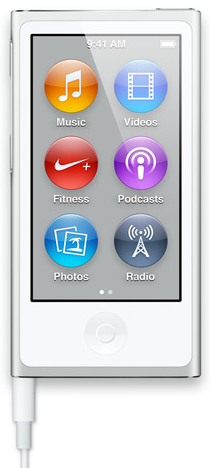
 

If you didn’t know it didn’t run iOS, you’d have no idea. Apple went out of their way to change the iPod nano, a device whose sales are most likely falling off, to look an awful lot like an iPhone or iPod touch even though it isn’t. It is even multi-touch capable. Could the next generation run iOS, handle entry via voice, and offer cellular calling?

Apple today uses various generations of iPhones to cover a wide umbrella of price points. I am speculating that Apple, in the future, could use three different devices to do the same thing they do today. At the high-end, a pro 4″ screened device, at the mid-tier a classic 3.5″ screened device, and at the low end a nano 2.5″ screened device. Instead of each device coming with a cellular chip, 3G/LTE would be optional just like on the iPad. The iPod line goes away and Apple ends up with an iPhone pro, iPhone classic and iPhone nano filling in the product line.

  • iPhone pro (64GB): $649
  • iPhone pro (32GB): $549
  • iPhone pro (16GB): $449
  • iPhone classic (64GB): $399
  • iPhone classic (32GB): $299
  • iPhone nano: $149

I like straight lines and simplistic presentation, just like Apple. The current line-up is confusing at best and it seems to me that the differences between iPhone, iPod touch and iPod nano are quietly blurring. A future where cellular technology is optional — just like the iPad — seems like a safe bet. If this happens, I’d expect it two years from now.

On The iPhone 5 and Apple Numbering Schemes

On the eve of Apple announcing their next iPhone, there has been a lot of discussion regarding what Apple should name it (here and here for thoughts). Traditionally Apple ignores generational naming of products to stick with a simple message. You don’t have a MacBook Pro 48756E; you have a MacBook Pro. It’s an iMac, a Mac mini, a MacBook Air, an iPod nano, an iPod touch.

The only two places Apple moved away from this was the iPad and iPhone. We had the iPad and then the iPad 2. On the iPhone we have had the iPhone, iPhone 3G, 3Gs, 4, and 4s.

How do we identify different generations of devices for support purposes? In technical terms there is an ID, a short numbering system that defines the version and unique characteristics. For example, the latest iPad release is known as “iPad3,1”, “iPad3,2” or “iPad3,3”, indicating the third generation iPad where 1 is the wifi model, 2 the GSM model and 3 the CDMA model. There is also an external model number, about five or six characters that indicate the same information but more cryptically. For the rest of us, though, we tend to refer to it by its physical characteristics plus release date: “a spring 2012 iPad with AT&T 3G.”

Recently Apple dropped the generational numbering from the iPad, which made perfect sense to me (explained below). But what has been a topic for discussion has been whether Apple will drop the generational numbering from the next iPhone. I am doubtful and it seems my doubts were confirmed by the card sent to the press, which shows the announcement date casting a “5” shadow:

I believe that Apple persists with the generational numbering on iPhones and no other device because it is the only device Apple sells where they rely on third-parties to sell it. The vast majority of Apple devices sell either through its website or via an Apple retail store. But the iPhone sells a vast number of devices at carrier stores throughout the world.

Apple has no control over those employees, doesn’t train them and steep them deeply in Apple’s culture. Because of this, Apple is stuck with generational numbering for iPhones and none of their other devices.

Who’s Making Money in Mobile Apps?

I’ve come to the conclusion that four groups are making money in mobile apps:

  1. Companies Who Make Games
  2. Companies Who Make “Pick Axes”
  3. Companies Who Use Apps To Sell Other Stuff
  4. Companies Who Develop Apps For Others

Games

Gaming is clearly the place to write apps and make lots of money. Trey Smith performed some interesting analysis. 22 of the top 25 grossing iOS apps were games (at the time of his analysis). All but four of those (18 of 25) were free-to-play with in-app purchase. Trey determined that the most successful games had the combination of lots of in app purchases and calls to action:

It’s pretty simple really… the more options you give your customers to purchase things the more money you will make.

This is because there are only a small percentage of users out there who spend money in games (like me).  Even though the percentage is small, typically those customers are interested in spending a LOT if they like the game.

Based on some released data, He determined that the #9 app was grossing $12 million per month in sales and an app that maintains a top 5 ranking for the year would gross at least $110 million. That’s an awful lot of Infinity Softworks’.

Pick Axes

Scott Kveton, CEO of Urban Airship, called his company a pick-ax company, as in selling pick axes to miners during the gold rush. Urban Airship, like appFigures, Flurry and others, sell services to developers. And clearly they are killing it. Urban and Flurry have raised at least a combined $45 million [1] and the CEO of appFigures told me he has been profitable since the company started.

Sell Stuff

I heard that eBay will sell billions of dollars worth of merchandise through their mobile apps this year. That’s billions with a B. But it isn’t just eBay that’s doing it. Evernote, too, is using a free mobile app to sell subscriptions to their service. And I’m not certain companies like Uber could even exist if it wasn’t for their mobile apps. None of these directly make money from the mobile app. Instead, they sell products or services by using app stores to get customers and apps to engage them. Using mobile as an entry point to a broader market or opportunity seems to be working for a number of companies.

Develop Apps

Small Society made a nice living creating apps for the Obama ’08 campaign, Starbucks, and ZipCAR, among others, before being acquired by WalMart Labs. The company that wrote the eBay app also wrote the app for Weight Watchers before eBay realized they needed to own the talent who wrote the thing. There are tons of these examples. Big companies have deep pockets and there’s an endless need for Android and iOS developers. Besides, custom development gigs have been a staple of software development long before the iPhone came on the scene.

Given that, it isn’t just traditional “contract houses” that seem to have made good money. There is a cottage industry of white label app companies as well. One of the ones I am more familiar with is Oceanhouse Media, who created a series of Dr. Seuss, Berenstain Bears and Mercer Mayer Little Critter books all using a standard software platform. Develop one product, customize it over and over again for different purposes, ship!

Let Me Sum Up

My conclusion: if you aren’t apart of one of these four groups then good luck building a company, let alone making enough to support yourself.

[1] Making a false connection between a company doing well and a company raising lots of money. In this case, I believe Urban Airship is profitable and suspect Flurry either closely controls their cash flow or is also profitable.

AT&T Rolls Out Mobile Share Plan

AT&T rolled out a new plan last week called Mobile Share.

Instead of paying for each minutes, texting and data separately, all of these are bundled together into one base price and a price per device. For instance, we were paying $80 for 1400 minutes, $30 for unlimited text messaging, and $15 to $20 per phone for a small bucket of data (200-300 MB). We have three phones, one each for my wife and I and another phone that used to be Infinity Softworks’ primary line [1]. The total bill, excluding taxes and fees but including the extra device charges, is $180.

My phone and my wife’s are both iPhones. The company line is an Android phone. I had to buy a data plan for the Android phone even though it never leaves the house. That’s 300 MB per month that goes unused. My wife also doesn’t use much data on the go and I am routinely pushing up against my 200 MB limit, especially if I travel at all during the month. I sometimes pay an extra $15 in a month to get more data even though as a family we never go over the total 700 MB per month allotted between the three phones [2]. Most months we are also right around the 1400 minutes for calls, slightly above or slightly below. Luckily, AT&T’s rollover minutes keep us from paying per minute.

With the new Mobile Share plan, we get unlimited telephone, unlimited messaging and the choice of shared data. The base price goes up and the cost to add a device goes down depending on the allotment of data. For instance a 1GB (1024MB) shared plan is $45 base plus $40 per phone, the 4GB shared plan is $70 base plus $40 per phone, and the 6GB plan is $90 base plus $35 per phone.

The more phones the more effective the pricing gets. At 1GB, we will pay $165 per month for the three phones. Not only do we save $15 per month but it is far less likely that we will have to pay extra for data and I no longer have to think at all about voice call minutes. In addition we can use FaceTime over 3G now if we want (which the tech press is having a cow over but whatever). When the next iPad ships I can add it, too, for $10, which saves me another $10 per month as the current plan for its own data bucket is $20.

All in all, a nice plan. We switched this weekend.

[1] We keep it around to tell people to send an email. Plus I like the idea of having an extra phone around the house in case of an emergency.

[2] 700 MB doesn’t seem like a lot but it is when on-the-go stuff is mostly focused on email, web searches, etc. In other words, I only do text-based stuff. I don’t download apps and don’t watch videos. The largest thing I do on the go is download maps and occasionally use the GPS system. Of course, most of my time is spent under a wifi umbrella…

Micro Apps Suck

I’m very frustrated with the state of apps. It seems instead of getting more powerful applications that focus on solving a big problem we are getting smaller and smaller apps that focus on a subset of the problem.

Let’s start with photo taking. I don’t want one app for photos and another for video and another to share pictures and another to shoot panoramic. I want one app. Apple alone provides three photo apps: camera, Photos and iPhoto. There is a logical line between iPhoto and the other two as the former is focused on editing pictures and the other two are focused on taking, seeing and sharing photos. But why both camera and Photos? Why not give me a button in the camera app to see my pictures, share and delete them? And the same in the Photos app? I want one app on my home screen.

Apple is making this horrible mistake again with Music and Podcast apps. Apparently in the next OS version Apple removes Podcasts from the Music app and forces you to download a new one from the App Store. I listen to both music and podcasts. Why do I have to have two apps? My first problem is that my car does bluetooth streaming seamlessly with the Music app. Now I will have to specifically go launch the Podcasts app to listen to them. The second problem is that if you download an mp3 file that happens to be a podcast but not labeled as a podcast it will not be organized at all with the other podcasts.

This splitting into micro apps is causing me to create folders on my home screen, making it harder for me to find apps and causing me to drill down too many levels to do the things I do all the time. This tread across the App Store is driving me nuts.

Here is the logical approach. I say to myself, I want to listen to something and to listen to something I launch the Music app. Then I look for what I want. Easy!

In this new universe I have to decide what I want to listen to, figure out where that may be stored and then run that app. If I don’t know where it went then I am hunting around looking for it.

Apple, this is worse than files and folders. And I know how much you dislike files and folders.