Why Did You Start Your Business?

I went to a Founders event last night. There were probably 30 or so people there representing about 20 companies. I wasn’t able to stay long but in 45 minutes or so I talked to a handful of these companies. The conversation went something like this:

“Hi, I’m Elia.”

“Hi, I’m <whatever the persons name is>.”

“What does your company do,” I’d ask?

“We develop <whatever the company does>.”

Then the question I asked that surprised me the most:

“Why did you start this business?”

I have no idea why I started asking that but it struck me as a better question than most others. In a number of cases I heard them explain that they had a personal problem they were solving. In other cases they saw a market opportunity and could relate it to their own experiences. And in still other cases the person had some rambling, jargon-strewn response that didn’t make much sense to me. It seemed to give me instant insight into that founder, their experiences and how likely they are to persevere when they hit roadblocks.

I walked away trying to explain that to myself as well. Why did I start Infinity Softworks? I hated my college calculator. I was tired of seeing a tiny little number in a tiny little window, having to remember an arcane set of keystrokes to calculate.

In 1979 Jimmy Carter was President and established diplomatic relations with communist China for the first time. The shah of Iran was overthrown which eventually led to the Iran hostage situation later that same year. Nickelodeon debuted on Warner Cable, Sony debuted the Walkman in Japan, and McDonald’s debuted the Happy Meal. Michael Jackson’s Off The Wall was the hit album of the year. In 1979 the entire PC industry sold 535,000 units and was dominated by Tandy TRS-80 (Trash-80 for those that don’t remember), the Apple II and the Atari 400/800. There was no publicly-available Internet. Everything was shared via tape drive and 5.25″ floppies.

And we did math with spreadsheets and pocket calculators, the same as we do today.

So why do I persist at Infinity Softworks? Because performing math hasn’t changed in 33 years. And it is time it did.
The Awesomeness That Is VoiceOver

We started work on version 3 of powerOne for iPhone, iPad and iPod touch this past week. While I am not ready to announce what made the cut and what didn’t, we do hope to ship it to Apple in about a month. It will be a free upgrade to current customers.

One of the requests we got was to enhance our support for Apple’s accessibility feature called VoiceOver. Our customer said, “This app isn’t perfectly compatible with VoiceOver, Apple’s built-in text-to-speech technology, but it is the best I’ve found so far.” I’m really glad she wrote because powerOne is perfectly geared toward the sight-impaired and with version 3 it will be even better.

How does VoiceOver work? There is a setting in the Settings app (General then Accessibility) that when turned on lets you tap a button, label, or control once to hear what it is and then double-tap anywhere on the screen to activate the button or flick to move the slider. It is a little arduous but I can only imagine how hard these devices are to use for the visually impaired without it.

For the most part the iPhone and iPad is really smart. It does things like read the contents of table cells and labels. Today the templates work quite well as Apple reads the label and value in each cell when tapped. But the calculator and number editors are filled with buttons with graphics and it reads the name of the graphic used on the button. Other problems include the fact that it doesn’t tell you the settings correctly and it didn’t read the result of a calculation.

We went through and spent the better part of a day assigning all those details. For instance choosing the decimal precision now tells you the current setting and as you move the slider it reads it to you: “0”, “float”, “1”. Every calculator button now says what it does, every toolbar and navigation bar buttons says what it does, it even reads the help to you. And now when you complete a math problem, algebraic or RPN mode, it reads you the result.

This was one of those features that would have been easy to justify away. After all, how many sight-impaired customers could we possibly have? But it is rare that we get a chance to implement a feature that truly helps people better themselves, to help those who would otherwise need help do for themselves. In some ways the time spent enhancing powerOne for VoiceOver felt like no time at all!


Finding Your Inner Milkshake

The hiring and firing of milkshakes and candy bars

Horace Dediu is one of the most influential and insightful analysts in the mobile market these days. I just started listening to his podcasts. The one I linked to above is an interview with Bob Moestra, who is executing on a simple Clayton Christensen idea.

The short summary is thus: products are hired to do a job. The key to each successful product is figuring out why the product was hired and then executing product, marketing and sales around that job.

Christensen’s example is one of a fast food chain that found that some customers were buying milkshakes in the a.m. Why? Turned out the commute was long and boring and they wanted something to do. Eating a bagel or sandwich was too messy. Drinking a milkshake kept them busy without risk of a sullied shirt and filled them up until lunch. The milkshake was being hired in the morning to help fill travel time and an empty stomach.

In the tech space one obvious example of a product that has figured out why it is hired is DropBox. DropBox is hired to give access to all my files wherever I am. The folks running DropBox have done a fabulous job engineering all facets of its business around this idea, even with new features like automated scripts for doing stuff on available files. What I admire about the company is that it realized not only what it was being hired to do but also that all the other noise needed to go away. No settings, no special processes, nothing. Just drop it in a file and go.

Even our very own powerOne has a clearly defined job: give you answers to your math and finance questions fast and easy. Believe me, we have tried over the years to expand its job but it has never worked. The product’s job is give a result fast and easy. Everything else is superfluous.

(As an aside this is why companies go astray, I believe, as well. Those developing it forget why it was hired. I also think this is why Siri is beta. It isn’t because it is not feature complete. I think it is because Apple doesn’t quite know what job you are going to hire it for.)

A couple of years ago I went to a TechTalk sponsored by Apple in Seattle. One of the things I took away from there was a distinct phrase that Apple uses for each one of their products:

Your differentiator your solution for your audience

In other words, what job is your product being hired to do by what audience.

Once we figure this out, the rest is staying focused and executing.

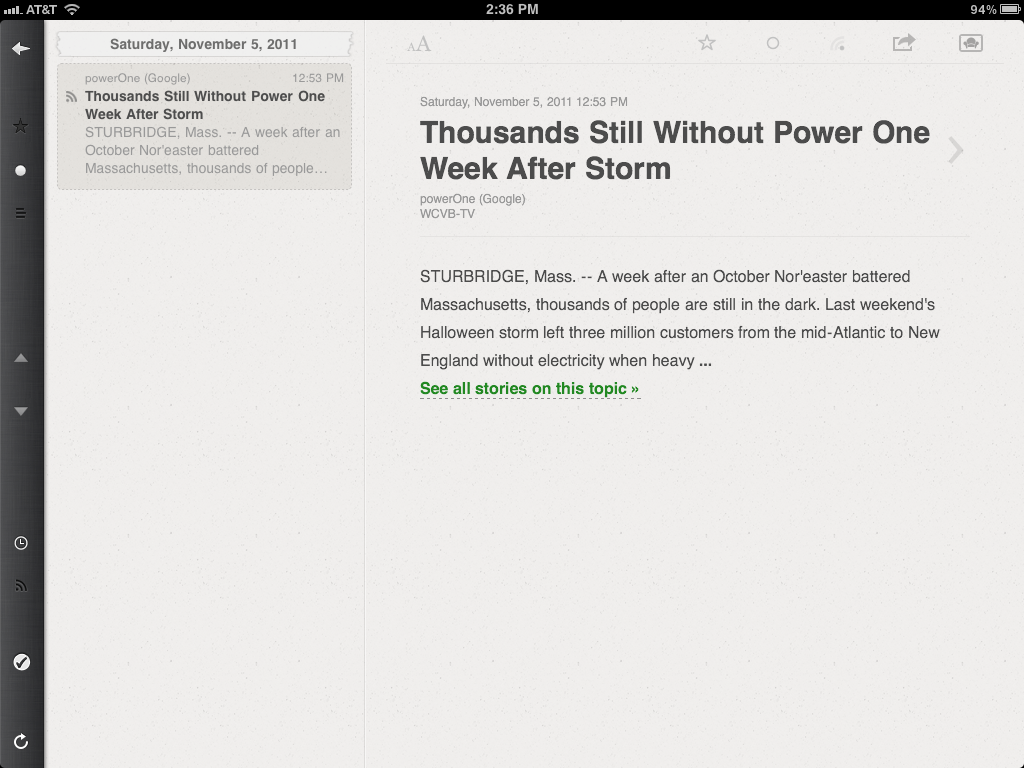
Storm Victims Missing Their powerOne Calculator

Oh the humanity! Thousands without my powerOne calculator a week after the storm!

I monitor instances of “powerOne” all over the web with some tools that Google provides. It is neat to see what people are saying and who else is using the term “powerOne.” Sometimes, though, it will catch two words that are close in proximity and Google will show that post to me. In early November the above post was waiting for me one morning when I opened my Google Reader app on my iPad (an app called Reeder).

Obviously not funny for those without power. But if read slightly different…

Innovation By Limiting Options

As we work on a new project here for the first time in a decade I am thriving off some simple restrictions we put in place and causing me to be more creative. Those restrictions:

  • Should adjust naturally to screen size changes
  • Should be easily portable to other operating systems
These two issues have become major stumbling blocks for powerOne. powerOne is highly dependent on the screen dimensions of the device because of the calculator and the editors. It also takes a lot of work — 9 months to a year — to move it to a new operating system and device. Both of these issues make us slow moving in a market that is moving ridiculously fast.
This new project, which will remain nameless for at least another couple of weeks, is designed from the beginning to be a lot more portable. We have leveraged some existing code and existing iOS experience. We are about to enter a final testing phase with the product just three months after starting.
I like putting artificial limits on products, bounding the box with which I work. Creating restrictions forces creativity to flow in alternative directions and I hope, once I start showing the new app, that you’ll agree that boxes were placed in the right spots.