It Took Me 15 Years To Figure Out My Professional Theme

I learned something about myself last week that surprised me: I really am not big into math.

Your laughing about now, right? After all, I’m a guy who has spent the past 15 years making calculators. I know, it surprised me, too, when I made the connection.

To be honest this has always kind of bothered me. I never did poorly in math in school but I never excelled at it either. In high school I got an A or B in Algebra and Algebra II and a B- or C in Geometry and Trigonometry. I got a C in statistics. I was never in the advanced classes; just at grade level, and my math grades were usually some of my lowest. By my senior year I had two math classes and used to skip them both to go the journalism room or computer room to write code. Sometimes a buddy and I would skip them and go to the mall for lunch. In college I took two quarters of Calculus and got a B+ both times and then took Statistics and still couldn’t do better than a C, but I worked my rear end off to get those grades and never really did understand what I was doing.

I really didn’t excel in college until I switched to business — accounting — and then transferred to a new school but I never really loved accounting per se. I figured the high grades were because I had figured out how to study plus the subject material came more naturally to me then engineering. It was the programming classes, once I started taking them again my junior year, where I excelled.

So when I graduated and started writing calculators for the PalmPilot it just didn’t make sense other than I saw a need and fulfilled it. It has taken me fifteen years to realize what the overriding theme of Infinity Softworks has been, even though I’ve been pursuing it the entire time.

You see, it isn’t about math per se. It is about numbers.

Working with numbers has been the constant theme throughout my professional career. Mathematics is just one way to work with them. Before I learned to program I used to create paper, dice and card-based baseball and football games. When I learned to program I wrote a basketball game, using player stats, and a golf game. The golf game used basic physics and vectors to determine ball flight path.

In the PalmPilot days I wrote a general-purpose financial calculator, loan and lease calculators, investment tracking, and personal finance tracking products. Once we added more people we developed scientific and graphing calculators. I have also tried to develop new things a few times over the years: an education specific math app called MathPoint, a data capture app called FastFigures.

The constant theme? Every one of those are about working with numbers.

Why did this dawn on me now? Because a friend, in relation to a new project that I can’t wait to share, changed a single descriptive word from “calculation” to “numbers” and suddenly it hit me like a sledge hammer.

I’m so glad he said it. Everything makes far more sense now.
The Features That Make Us Drool

Sean Ellis, writing in a post about a new product he has been working on:

With each new startup, I immediately started working to uncover the “must have” experience before I formed preconceptions about how and why a product would be useful.  This involved a rigorous process for identifying the most passionate users and then getting their unstructured feedback about how they were getting value.  With each new cohort of users that I engaged, I began to get more structured feedback to converge on a signal of the “must have” experience.   Once I had a clear signal, I could work with the team to start aligning the business around the “must have” experience.

I also found that it was important to monitor this “must have” experience over time.  Each new product update can change it.  Shifts in the competitive landscape can also affect it. For an experience to be a “must have” it should be both valuable and unique.  The emergence of a new competitor can instantly turn your “must have” experience into a “nice-to-have” experience.

Must-have versus nice-to-have product concepts have been around for a long time. Pills versus vitamins was another way we referred to it a decade ago.

The story for powerOne has been primarily the same and can be summed up in two words: easy and fast. Those two words have been the consistent customer must-haves for the last 15 years and we have always tried to keep those in mind while working on the product.

But the competition has exploded, too, over those years. When we released our first financial calculator, FCPlus Pro for PalmPilot, back in 1998, there was only one other financial calculator and only a couple of scientific ones for that platform. Now there are dozens of financial calculators and thousands of calculators in the iOS App Store.

The must have features have remained the same but there are a lot more products now, making it harder and harder to differentiate. We have tried — library of add-on calculations, storing your history, a simple language for creating custom templates with advanced capabilities — and will continue trying. The must-have features remain the same, though.

This has been a fun and exciting decade and a half. I hope I get to keep doing this for a long time and hope our customers continue to enjoy our efforts.

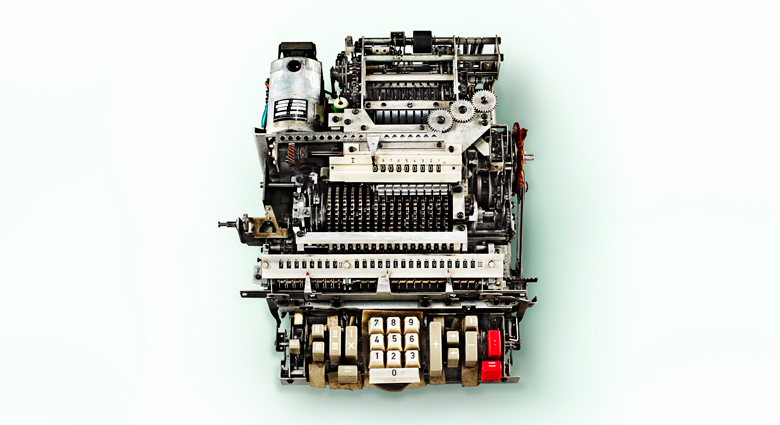
The Guts Of An Old Machine

Interesting photos of mechanical calculators from the 1960s at Kevin Twomey’s web site. Here’s a sample:

There’s also a pretty cool, short video about the guy who is collecting these.

The lengths we went through to do math — even simple add and subtract — was amazing. The side views are particularly cool. There must be thousands of gears, levers and switches that make these things work. In the video he said that one of these machines could cost upwards of a $1000 in 1960s dollars (around $7000 today) and these were the pinnacle of technology at the time.

The collection belongs to Mark Glusker, who actually has even more information on his own web site. One of the things I find interesting about these machines is the button locations. On electronic pocket calculators that layout was standardized. But in the mechanical calculator days there was a ton of experimentation.

The iPad, by comparison, can do a lot more with a lot less parts. Of course try fixing an iPad yourself. You can’t. But if you were mechanically inclined you can easily fix one of these calculators.

Frighteningly Ambitious Startup Ideas

Paul Graham wrote this very interesting post a week or so ago about ridiculously hard startup ideas:

One of the more surprising things I’ve noticed while working on Y Combinator is how frightening the most ambitious startup ideas are. In this essay I’m going to demonstrate this phenomenon by describing some. Any one of them could make you a billionaire. That might sound like an attractive prospect, and yet when I describe these ideas you may notice you find yourself shrinking away from them.

Don’t worry, it’s not a sign of weakness. Arguably it’s a sign of sanity. The biggest startup ideas are terrifying. And not just because they’d be a lot of work. The biggest ideas seem to threaten your identity: you wonder if you’d have enough ambition to carry them through.

The weird thing is I didn’t blanch at any of the first five (I have no experience to blanch or not blanch at the last couple). In fact, I have given serious thought to the second one and even have a product idea for carving off a slice of the email market. Honestly, I’m mostly interested in big, world changing ideas and don’t generally see the point of small ones.

I guess this means I’m insane? I’m sure there are a few of you out there who know me nodding in agreement about now.

We Are All Failures Until We Are Not

As Chris Dixon pointed out the folks behind Angry Birds, a company named Rovio, was around for eight years and had developed 52 games before finally making it big. They almost went bankrupt a few years ago. I heard somewhere that their expected 2012 revenues will be around $400 million.

As Chris said:

You tend to hear about startups when they are successful but not when they are struggling. This creates a systematically distorted perception that companies succeed overnight. Almost always, when you learn the backstory, you find that behind every “overnight success” is a story of entrepreneurs toiling away for years, with very few people except themselves and perhaps a few friends, users, and investors supporting them.

In other words, we fail until we don’t.

It strikes me that this is the case in almost all walks of life. I’m watching my eldest daughter learn to read. She has been learning for almost two years now, starting somewhere in her third year. She failed at it until now.

Failure isn’t the end, and that is what I like about calling it failure. Failure is a good reason to try again.

Just like with my daughter. She didn’t get discouraged. She just kept trying.