I am proud to introduce you to Equals. Our goal with Equals is to make working with numbers as easy as writing sentences. While we only have a web site up right now, the products and services are coming soon. Please email me with any comments or feedback, and hope you will be interested enough to sign up for notifications at the Equals web site.
We have had many successful years developing powerOne calculators, combining aspects of spreadsheets and calculators into the template format. But the world has changed drastically over the past few years, especially since the iPhone App Store launched in 2008. powerOne was built and designed for that pre-App Store world.
We’ve been looking for something new for a while, something we can build a long-term business around, one that fulfills my thesis that the tools we use to work with numbers need to change just like the PCs we use those tools on have. A few of the reasons we are so excited about Equals:
Customization
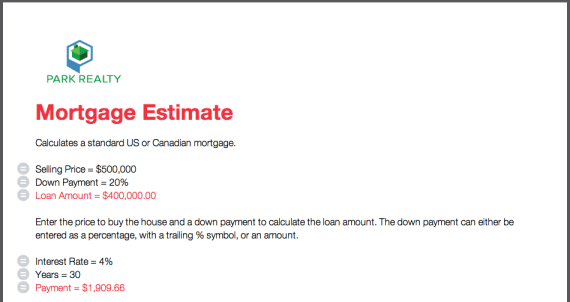
What made spreadsheets incredible is that, while they still required some basic algebra (B3 is nothing more than a variable, after all, no different than X), it allowed customers to craft spreadsheets concretely. Enter a value into B1, another into B2, then add them up with a simple =B1+B2 formula. Immediately the customer can see the results, even change B1 and B2 to see the impact.
powerOne… not so much. In powerOne the scripting language is more akin to programming. The author must think through the entire calculation, remove the equations from the data, and craft the template. Then he or she can plug in numbers to see if it works. This is hard for most people to visualize.
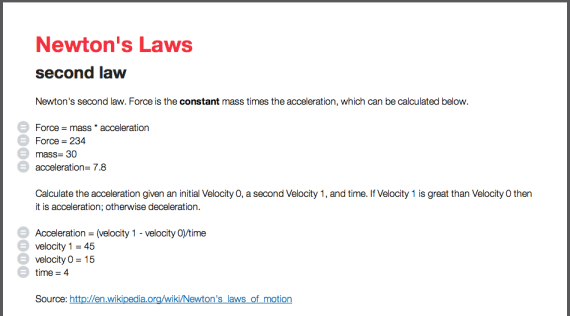
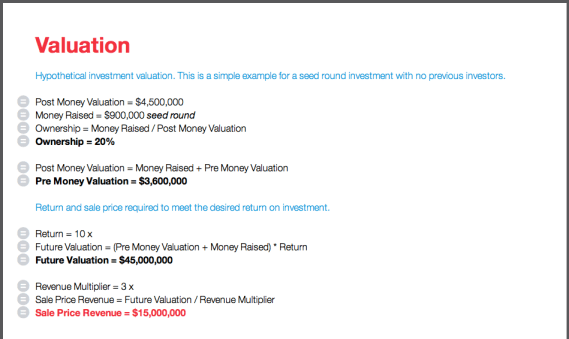
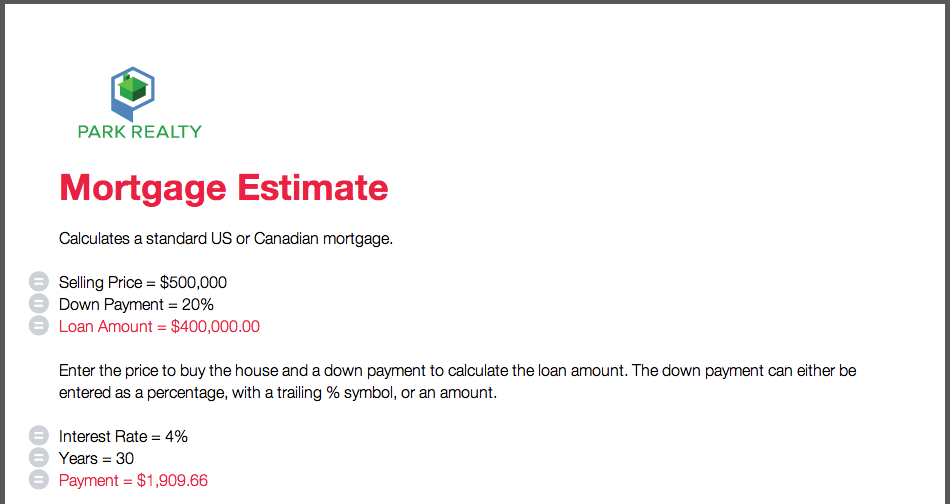
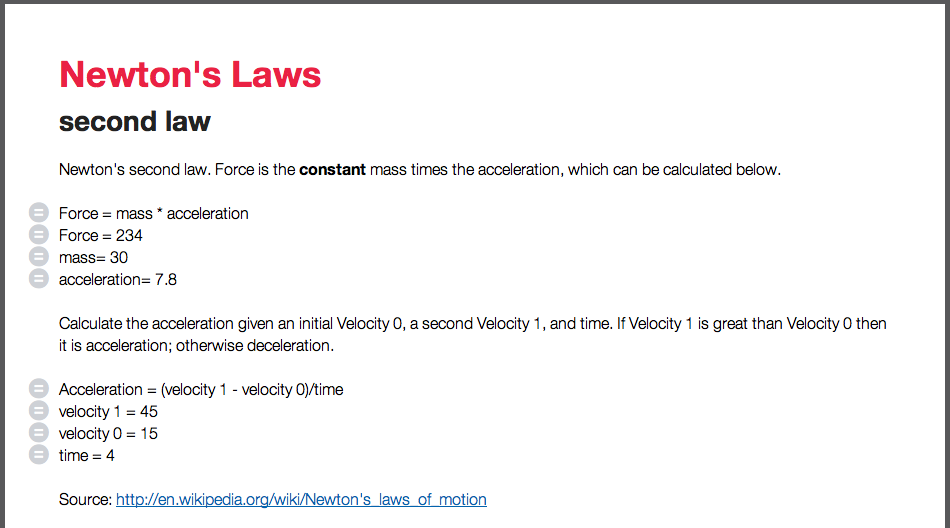
Equals is more like a spreadsheet in this regard. It is much easier to build calculations from the data. But we wanted to take this a step further. Could we start making variables look like sentences so customers didn’t even need to think in algebra at all? In Equals I can name a variable anything, with only a few limitations (for now):
2013 Q4 Sales
Interest Rate
Avogadro’s Number
Acceleration
It worked so well that after a few sessions with Equals it became clear that I could read notes just like I was reading a page with text. I could understand the variables, understand the equations, whether I wrote them or not. This opened up calculations so not only can anyone write one, but anyone can take someone else’s note and customize it to their own needs. This is critical. Life is custom, after all.
Finally, we realized that the way people looked at the numbers physically is different. powerOne and Excel both expect to see calculations in a very specific format. Sometimes that format made sense and sometimes we copied and pasted numbers into Word and other text editors to layout the numbers.
This is no good. These arbitrary barriers between form and function were designed for an era when computers could only handle one or the other. That’s not a problem any more.
Internationalization
powerOne is filled full of text. There are thousands of words of help, template descriptions, labels and more. The cost to bring powerOne to a language other than English was astronomical, let alone our lack of understanding of certain calculations in other countries. Back in the Palm OS days we weren’t hurt horribly by this fact. Now, though, non-US sales of apps, by some reports, account for most app revenue.
One of our goals with Equals was to get Infinity Softworks out of the middle of this localization. The apps and site we are working on is more iconic, less text-centric. The product is your notes, your calculations. Let them be designed and presented in the language of your choice. There will still be some work on our part to localize Equals. That’s fine. Just so long as it isn’t overwhelming.
Cross Platform
As if localization wasn’t bad enough, powerOne is a bear to port. At a minimum we are looking at six months of intensive work for multiple people and that doesn’t include on-going maintenance and support. iOS couldn’t pay the bills around here. Android has been even worse. The motivation to develop for any other platforms is at an all-time low.
When we started working on Equals one of our goals was to make sure we could move across platforms more easily. We focused on putting as much of the technology in HTML5 and ANSII C so we could run it on multiple platforms more easily. This doesn’t mean everything is in HTML and C, however. It means certain core technologies are. We are testing this immediately with both iOS and web versions. We are excited to add Android and other platforms as well.
App Stores
App Stores are an unbelievable resource. The iOS App Store eliminated 70% of our support burden just by handling the install and reinstall issues we encountered in the past. While the App Store is an amazing resource for distribution, it is a horrible resource for making a living wage. We are excited to introduce a product and service that we think is not just valuable to customers but also sustaining for us as well.
In addition, getting out of the app stores allowed us to think more broadly. What does it mean to share calculations? How could this be done easily? What would be an appropriate business model that allows us to get paid and for customers to have a valuable product, whether or not the app stores will support that model?
Don’t get me wrong. The app stores have their place. We just intend to use them for what they are really good at.
Long Life
I like products I can think about and work on for a long time. After 16 years, powerOne has reached the end Yes, there were some things we could do to it, features that customers wanted, but the big ideas were already there.
Equals is exciting to me. It has long legs. The way customers will use it, the enhancements we can make to improve it from collaboration to data to integration with other services, gives me years and years of material to work with.
I hope you are excited. Equals ushers in a whole new era for working with numbers, one designed for the web and mobile world we all live in today. The site is ready for your review today; the service, mobile and web apps very soon. I hope you will check it out and tell me what you think.

 Elia Insider