Twitter, Apple and the Paradox of Partnering

The last two weeks have been mind-blowing. In succession Apple launched the iPad, announced iPhone OS 4 (used in iPhone, iPad and iPod touch devices), changes in Apple’s license agreement sent the developer world (particularly Adobe) into a tizzy, and then, as a topper, Twitter bought the maker of Tweetie, a Twitter client.

There is amazing power and tremendous risk in partnering and these four events clearly show the risks and rewards.

Let me be clear that this is no manifesto for going alone. The reality is, as a start-up, we are really made or broken by our initial luck in partnering, whether that’s using someone else’s hardware and operating system, an initial customer, or a strategic relationship with a big partner.

On the positive side, Apple’s iPhone OS and devices running it have brought smartphones to millions of people who never used one before, opening up purchases of third-party apps in a way that has never been done before, and that has created a number of newly wealthy developers (not me). On the other hand a change in two paragraphs in Apple’s license agreement has potentially wiped out a handful of other companies’ businesses.

Twitter has also brought something new to millions of customers, namely a new communication platform. And in one move it might have wiped out thousands of other companies’ businesses by making a choice and buying one of them.

Infinity Softworks has benefited in some ways, too. Almost unrecognized in the iPhone world, being there at launch coupled with Apple’s decision to ship no calculator with the iPad has raised powerOne revenues to breath-slightly-easier levels.

I have learned to ask clear questions about these relationships: Is the partnership short-term or long-term? Is the partner committed to the relationship? Is it likely that we will get in the way of their bigger strategic goals?

Sometimes I guess right. We had a lengthy and fruitful bundling relationship with Palm and other Palm OS licensees, but we were dumped when Palm used an alternative product instead. We were also making tremendous headway in education when Palm decided there was no future in handhelds (ha, ha), shifted focus to smartphones, and fired their education team.

Even when we fit perfectly, it’s not always easy to see how the relationship will work out. (It’s also not every day a company makes a billion dollar investment in a market and then backs out on a dime but that is just the epitome of how poorly Palm’s been run.)

If I’m on the web I’ve got to ask myself these questions about Google, Twitter and Facebook. If I’m reliant on Apple, I’ve got to ask these same questions of it.

And then I have to hope I’m right.

A Crazy Couple Of Weeks

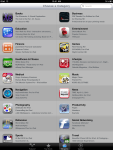
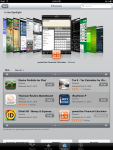
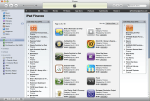
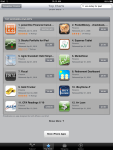
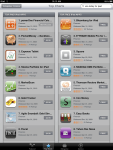
Wow! This has been a great couple of weeks. Two weeks ago we were still discussing an iPad version of powerOne calculator. Since then I have had lots of meetings, a trip to Apple HQ (with Dick Luebke), shipped an iPad version of powerOne (universal as the same version works on iPhone, iPod touch and iPad), a new device arrived (the first time in my personal history I have ever bought a first generation technology — I’ve been dying for a tablet device like the iPad for a decade). Finally we were featured in the iPad App Store and… a #1 ranking in the Finance category!

A few pictures to remember these couple of weeks by (click on a picture to enlarge it):

Apple and the Mainstream Tipping Point

Apple doesn’t always win markets and they don’t always invent them, but when Apple enters a market it is almost always the tipping point to mainstream adoption.

Proof:

  • The Apple II series was the first main stream computer. They eventually lost ground to the more business-friendly IBM PCs, but it introduced computing to the masses in a way no one before was able to. (And for us students, it is what we grew up using with the Apple IIe seeming to be in every school.)
  • Next came the Macintosh. It was the first truly mass consumed computer with a Window-based user interface. Of course, it lost out to Microsoft and Intel once Windows 3.1 and 95 were introduced.
  • We have to wait a while — 16 years actually — for the next major wave of computing. And this market Apple won: portable music players. While the iPod wasn’t the first (just like the Apple II series wasn’t the first) it quickly came to dominate the market and maintain its dominance through this day.
  • Next came the iPhone. Again, not the first smartphone but its introduction completely changed the landscape for cell phones, instantly raising the bar and inspiring competitors. The jury is out on this one. There is a long way to go when it comes to defining a winner as only about 2% of the cell phones sold worldwide are smartphones today.
  • And now we have the iPad. Unfortunately many media pundits are exclaiming stupidly that Apple is inventing the market. That’s far from the truth. Microsoft really pioneered the market 10 years ago with the Tablet PC operating system. For many reasons it was a flop. Apple is re-inventing it and from first take, doing it the right way with the right price.

So while Apple has not always invented the market or even been the eventual winner, the company (Steve Jobs?) has an uncanny knack for understanding exactly when a market is ready to go mainstream and is consistently a major player in the outcome.

Lets hope Apple’s 5 for 5 with the introduction of the iPad. I believe it is.

Disclaimer: I have a vested interest in Apple’s mobile success as powerOne calculator is available right now for iPhone, iPad and iPod touch.

Higher Taxes, Less Services A Thing of the Present

I live in Oregon. In the election in March we passed two new tax increases, one on people making $200,000 or so per year or more and another on all businesses. The business tax raised the minimum and also passed, for the first time in state history, a revenue (sales) tax. I contend that the business revenue tax is debilitating and will likely drive companies out of the state, particularly given that the next state over, Washington, is a 10 minute car ride from Portland.

In today’s Oregonian newspaper is an interesting article about how each state ranks from a tax burden perspective. According to the rankings by The Tax Foundation, Oregon dropped from number 8, ahead of Washington State in 2009, to number 14 for tax climate. Their ranking, available here in pdf format, takes into account corporate, individual, sales, property and unemployment taxes. Not as bad as I thought.

I still believe that the revenue tax will go down as a bad idea. I think the unintended consequences of the business revenue tax will make Oregon’s tax collection worse, not better, as it drives companies and employers away. It also puts Oregon on a different playing field from other states as it is an unusual tax for a state that has no personal sales tax rate. (Washington State has a revenue tax but they don’t have an income tax.) Infinity Softworks pays 4% more in taxes than my neighbors across the border, which isn’t a big deal until you realize we are talking about another employee ($80,000) on $2 million in revenues. And when we are losing money it is even more painful as now I have to pay the government instead of myself.

The reality, though, is that every state — and the nation as a whole — is soon going to have to re-think taxing and spending. Our governments cannot continue to support the current plethora of programs without raising taxes significantly (or vice-a-versa). Without cutting spending or raising taxes we will be dealing with much more significant problems soon enough.

Some Lessons I Need To Learn Twice

You’d think after 13 years I’d know better. Some lessons, though, are easily forgotten.

On Thursday last week we shipped version 1.1.2 of powerOne Financial Calculator to the App Store. It was accepted into the store on Friday. Saturday morning the first bug report rolled in that there was something wrong with template creation. It was pulling other templates in. Testing on this problem led me to a bigger problem — any templates created before version 1.1.2 were hidden from view.

On Saturday evening, after a half hour bug fix and a day’s testing we shipped version 1.1.3 to Apple, which was accepted into the App Store today. Luckily we escaped major catastrophe as neither bug was fatal — all previous templates were recovered and new templates are now created correctly again.

We have been at such a frantic pace here that we got lazy about testing. Sure, we were testing around the areas that were changed but we weren’t spending time testing everything before release. We didn’t think we had touched these areas — user-created templates — with version 1.1.2. We were wrong.

I learned this lesson the first time in March 1999. We shipped version 2.0 of FCPlus Professional… then version 2.0.1 then version 2.0.2 then version 2.0.3 all on day one. Nasty lesson learned.

So a reminder for this decade: write test cases, expand test cases, and actually step through them all before shipping.

A lesson learned that only caused a day’s panic and three days worth of consternation… but nothing else. Luckily.